
Behavioral interviews are evaluated against rubrics, not impressions. Companies like Amazon, Google, Meta, and Microsoft train interviewers to score specific dimensions on specific scales. Candidates who know the rubric score higher than candidates with better stories told less effectively. This framework walks through the structure, the rubric dimensions, the story bank you need, and the specific moves that raise scores at the most common interview formats.
Why Behavioral Interviews Exist
The hiring funnel treats behavioral interviews as the primary filter for two signals: whether a candidate will perform at the scope required, and whether the candidate's behavior patterns match the company's culture. Technical interviews can verify execution ability. Behavioral interviews are the only structured way to verify judgment, collaboration, and delivery over time.
Research on structured versus unstructured interviews consistently shows that structured interviews predict job performance roughly twice as well as unstructured ones. The STAR format turns a free-form conversation into a structured evaluation.
"The strongest predictor of interview performance at scale is whether the candidate can tell specific, detailed, measurable stories. Candidates who speak in generalities always score lower, regardless of their actual capability." — Lou Adler, author of Hire With Your Head
The STAR Structure
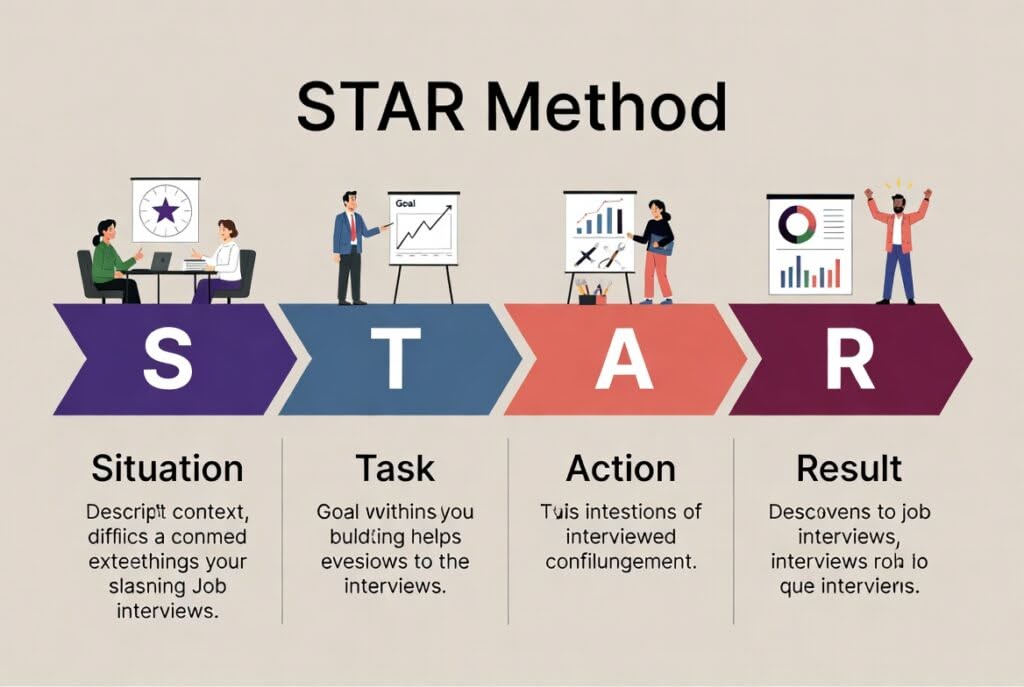
STAR stands for Situation, Task, Action, Result.
| Component | Purpose | Typical Time |
|---|---|---|
| Situation | Context and setup | 20-30 seconds |
| Task | Your specific responsibility | 15-20 seconds |
| Action | What you did and why | 60-90 seconds |
| Result | Measurable outcome | 20-30 seconds |
The Action portion should consume roughly half the answer. Candidates who spend too long on Situation or Task leave too little time for the section that actually scores.
The Action Expansion
Senior and staff candidates often make Situation and Task too long. The interviewer does not need the full company history. The interviewer needs just enough context to evaluate the decisions. A useful rule: the listener should feel mild impatience when you transition from Task to Action. That impatience indicates the setup was efficient.
The Rubric Interviewers Actually Use
Most structured interview programs score on five to seven dimensions. Common ones at major tech firms:
| Dimension | Positive Signal | Negative Signal |
|---|---|---|
| Scope | Owned end-to-end, led others | Narrow task, supervised |
| Ambiguity | Navigated undefined problems | Needed clear instructions |
| Impact | Quantified business outcome | Vague or missing measurement |
| Judgment | Explained tradeoffs considered | Only described actions taken |
| Collaboration | Named stakeholders, managed conflict | Solo work, no mention of others |
| Learning | Described what they would change | No reflection or growth |
Every STAR answer should intentionally hit at least three of these dimensions. Candidates who design stories around the rubric score higher than candidates with better stories told without rubric awareness.
The Story Bank You Need
Before any behavioral interview loop, prepare 8 to 12 stories that collectively cover the common question types. A story that illustrates conflict resolution can often be reused for "tell me about a time you worked with a difficult stakeholder" and "tell me about a time you had to give tough feedback."
The Core Eight
| Story Theme | Example Prompts Covered |
|---|---|
| Ambiguous problem you defined and solved | Biggest accomplishment, initiative taken |
| Conflict with a peer or manager | Working with difficult people, disagreement |
| Failure and what you learned | Mistake, failure, missed deadline |
| Cross-team or cross-functional delivery | Influence without authority, alignment |
| Technical tradeoff decision | Tough decision, design choice |
| Leadership or mentoring moment | Mentored someone, developed a junior |
| Customer-impacting incident | Under pressure, high-stakes situation |
| Continuous improvement or innovation | Process improvement, raised the bar |
Eight stories, each tagged to the dimensions they hit, cover the majority of a behavioral loop with room for variation.
Tagging Stories to Dimensions
Each story should be labeled with the rubric dimensions it can illustrate. A conflict story might hit Collaboration and Judgment but miss Scope. A cross-team delivery story might hit Scope and Collaboration strongly but need deliberate expansion to hit Ambiguity.
Interviewers are often instructed to score every dimension across the loop. If three stories in a row hit Collaboration but none hit Judgment, the dimension stays scored at the default. Candidates who distribute stories across dimensions produce more complete scorecards.
Amazon-Style Leadership Principles
Amazon's 16 Leadership Principles define their specific behavioral rubric. Bar raisers score candidates against these principles directly. Candidates with Amazon interviews coming up should prepare two or three stories per principle.
The High-Frequency Principles
| Principle | Typical Question Frame |
|---|---|
| Customer Obsession | Tell me about when you went above and beyond for a customer |
| Ownership | Tell me about when you took on something outside your scope |
| Dive Deep | Tell me about when you solved a problem by getting into the data |
| Bias for Action | Tell me about when you moved forward despite incomplete information |
| Deliver Results | Tell me about the most difficult goal you delivered |
| Earn Trust | Tell me about when you admitted a mistake |
| Have Backbone; Disagree and Commit | Tell me about when you disagreed with your manager |
Amazon interviewers are explicitly trained to drill down on specifics. "What was the exact metric?" "How many people?" "What did you personally do versus the team?" STAR answers that sound rehearsed without specific detail fail at Amazon more than at other companies.
Common Failure Patterns
Behavioral interviews have a finite set of ways candidates lose points. Recognizing them allows candidates to avoid them.
The "We" Problem
Candidates who say "we decided, we built, we shipped" cannot be scored on individual contribution. The interviewer does not know what the candidate did. Correct answer structure uses "I" for personal actions and "we" only for team achievements. "We agreed on the approach. I owned the implementation of the data pipeline."
The Generality Problem
"I had a difficult stakeholder once, and I communicated with them carefully." This answer is unscorable. The rubric requires specifics. Which stakeholder, what was difficult, what specific communication move was used, what was the result. Generic answers score at the rubric default.
The Missing Result Problem
"And then the project shipped." How did it go? What changed? Did metrics move? Did customers respond? Without measurable outcome, the Result section scores low. Even qualitative outcomes are better than no outcome.
The Happy Path Problem
Stories where everything went well from start to finish are lower-value stories. The strongest stories include an obstacle, a decision to navigate it, and the outcome of that decision. Interviewers looking for Judgment want to see tradeoffs considered, not clean wins.
"The question I always ask candidates in bar raiser mode is what did you do when it went wrong. If the story does not have a wrong, the story is not yet complete." — Dan Croitor, former Amazon Principal PM
Answering Frame by Frame
Here is an example answer structured to hit multiple rubric dimensions.
Prompt: Tell me about a time you had to influence someone without authority.
Situation: "At my previous company, our billing service was causing 30-second latency on customer login every time a payment method was added. The billing team owned the service, and they had deprioritized the fix three quarters in a row because their metrics rewarded feature launches, not latency reduction."
Task: "As the platform team lead, I was not their manager and could not assign the work, but my team's customer satisfaction metrics were declining because of this issue."
Action: "I took three steps. First, I built a one-page analysis with our observability data that showed the latency correlated with a 4 percent drop in purchase completion on the affected page, translated to $2.8 million annualized. Second, I scheduled a 30-minute meeting with the billing team lead and their director and presented the analysis with a proposed fix that would take two sprints. Third, I offered to embed one of my engineers to share the implementation load, which removed the staffing objection. I chose to lead with the business metric because I had seen the team respond to revenue framing in previous discussions, and I chose to offer engineer support because I knew capacity was their stated blocker."
Result: "The billing team committed to the fix in their next planning cycle. My engineer co-developed the solution. Latency dropped from 30 seconds to under 2 seconds within five weeks of deploy. Purchase completion recovered within the following month. The director later told me the embedded-engineer approach became their standard model for cross-team fixes."
This answer hits Scope (cross-team delivery), Ambiguity (navigated organizational constraints), Impact ($2.8M revenue), Judgment (chose metric framing and embedded support deliberately), and Collaboration (managed a peer relationship productively).
Preparation Protocol
A disciplined preparation plan produces substantially better interview performance than last-minute review. Three to four weeks is typical for a major loop.
| Week | Focus | Deliverable |
|---|---|---|
| 1 | Draft 10 stories from career history | Written STAR outlines |
| 2 | Tag stories to rubric dimensions, tighten Action sections | Revised outlines |
| 3 | Record yourself answering prompts, review for pacing | 20 recorded answers |
| 4 | Mock interviews with peer, refine based on feedback | 3 full mock loops |
Recording yourself is the highest-leverage preparation step. Most candidates cannot accurately self-assess pacing, filler words, or missing Result sections without playback. Two or three recorded answers often expose patterns that stay hidden in mental rehearsal.
The cognitive work of storytelling under pressure is substantial. Working memory, narrative sequencing, and emotional regulation all matter. The cognitive demands of interviews at What's Your IQ frame how stress affects retrieval of specific details, which is useful context for candidates who freeze during behavioral interviews.
Integrating With Technical Prep
Behavioral interviews rarely stand alone. They sit within a loop that includes coding, system design, and sometimes domain-specific rounds. Balancing preparation time is itself a skill. The system design interview framework at Pass4Sure covers the structured approach for the design portion. The IT career roadmap at Pass4Sure lays out the level expectations that shape behavioral rubric dimensions by career stage.
Behavioral preparation also improves salary negotiation performance because the same storytelling muscles produce more persuasive negotiation conversations. The six-figure salary negotiation playbook at Pass4Sure covers the specific moves that convert offers into higher offers.
Writing, Editing, and Delivery
STAR answers are written artifacts before they are spoken artifacts. Candidates who write and edit their stories produce tighter answers than those who freestyle from bullet points. The professional writing templates at Evolang include structures that help compress narrative into scoring-dense answers.
The same writing discipline applies to the resume that leads to the interview. Behavioral interviews probe the resume. Every bullet should be defensible under STAR questioning. Resumes with specific measurable outcomes produce easier behavioral interviews because the stories are already structured.
Study and Focus Environment
Preparation effectiveness correlates with focus quality. Candidates who prepare in distracted environments produce flatter stories. The productive study environments profiled at Down Under Cafe describe the deep-work settings that support sustained rehearsal without the fragmentation that erodes recall.
For retention of specific numbers, dates, and stakeholder names across 10 or more stories, spaced repetition helps. The study note frameworks at When Notes Fly cover the interval-based review that keeps specifics fresh across a multi-week preparation window.
Credential Sharing
Candidates advancing through final rounds benefit from shareable credential links for transcripts, certifications, and portfolio pieces. The QR code generation options at QR Bar Code produce scannable links for LinkedIn, email signatures, and resume verification.
Candidates moving into consulting or contract work after successful interviews may also need to consider business entity formation for tax and liability reasons. The business formation guides at Corpy cover the options for independent professionals across jurisdictions.
Senior-Level Behavioral Specifics
Senior, staff, and principal interviews use different rubrics than mid-level ones. Scope expectations increase. Individual output matters less than organizational outcome.
A staff-level story about conflict resolution might describe not just the conflict but the system that produced it and the change that prevented future recurrence. A principal-level story might describe the org-level culture change that removed the conflict category entirely.
Candidates promoted from mid to senior who use mid-level stories in senior interviews score lower because the stories do not fit the expected scope. Explicit rewriting of stories at higher altitude is often the missing preparation step.
"Senior candidates are evaluated not on what they did but on the leverage they created. Stories that describe leverage, not effort, score higher at senior and above." — Gergely Orosz, author of The Pragmatic Engineer
Practical Exam-Day Execution
The interview day itself has patterns that raise or lower scores independent of story quality.
- Start with a 15-second framing when the question is ambiguous. "Let me think for a moment." Structure beats speed.
- Name the structure out loud if helpful. "I have a good example from my team lead role. Let me give you the situation first."
- Watch for the interviewer writing. Long pauses in their writing mean the content is not scoring. Add a metric or specific detail.
- End each answer with an explicit Result and pause. Do not trail off.
- When pressed for more detail, answer the specific question rather than restating the Action.
The post-interview reflection is also underused. Candidates who take 10 minutes after each interview to note which stories they told, which dimensions they hit, and which they missed improve faster than those who treat each interview as a standalone event.
References
Adler, Lou. Hire With Your Head, 4th Edition. Wiley, 2021. ISBN: 978-1119808305.
McDaniel, Michael A., et al. "The validity of employment interviews: a comprehensive review and meta-analysis." Journal of Applied Psychology, vol. 79, no. 4, 1994, pp. 599-616. DOI: 10.1037/0021-9010.79.4.599.
Levashina, Julia, et al. "The structured employment interview: narrative and quantitative review of the research literature." Personnel Psychology, vol. 67, no. 1, 2014, pp. 241-293. DOI: 10.1111/peps.12052.
Huffcutt, Allen I., and Winfred Arthur. "Hunter and Hunter (1984) revisited: interview validity for entry-level jobs." Journal of Applied Psychology, vol. 79, no. 2, 1994, pp. 184-190. DOI: 10.1037/0021-9010.79.2.184.
Google re:Work. Structured Interviewing Guide. Google re:Work, 2023. https://rework.withgoogle.com/
Bock, Laszlo. Work Rules! Twelve Books, 2015. ISBN: 978-1455554799.
Salgado, Jesus F., and Silvia Moscoso. "Comprehensive meta-analysis of the construct validity of the employment interview." European Journal of Work and Organizational Psychology, vol. 11, no. 3, 2002, pp. 299-324. DOI: 10.1080/13594320244000184.
Amazon. Amazon Leadership Principles. Amazon.jobs, 2024. https://www.amazon.jobs/content/en/our-workplace/leadership-principles
Frequently Asked Questions
Why Behavioral Interviews Exist
The hiring funnel treats behavioral interviews as the primary filter for two signals: whether a candidate will perform at the scope required, and whether the candidate‘s behavior patterns match the company’s culture. Technical interviews can verify execution ability. Behavioral interviews are the only structured way to verify judgment, collaboration, and delivery over time.