
How long should a STAR method response be in an interview?
A complete STAR response should take 2-3 minutes. Shorter responses lack sufficient detail for evaluation, while longer responses lose the interviewer's attention. The Action component should take approximately 60% of the total response time. Prepare 8-12 STAR stories covering common competencies including leadership, conflict resolution, failure, working under pressure, customer focus, and innovation.
Behavioral interview questions are the questions most candidates dread the most and prepare for the least. "Tell me about a time you had a conflict with a coworker." "Describe a situation where you had to meet a tight deadline." "Give me an example of when you failed at something." These questions feel ambiguous, deeply personal, and impossible to prepare for. They are not. They follow a predictable pattern, and there is a proven framework for answering them clearly and effectively: the STAR method.
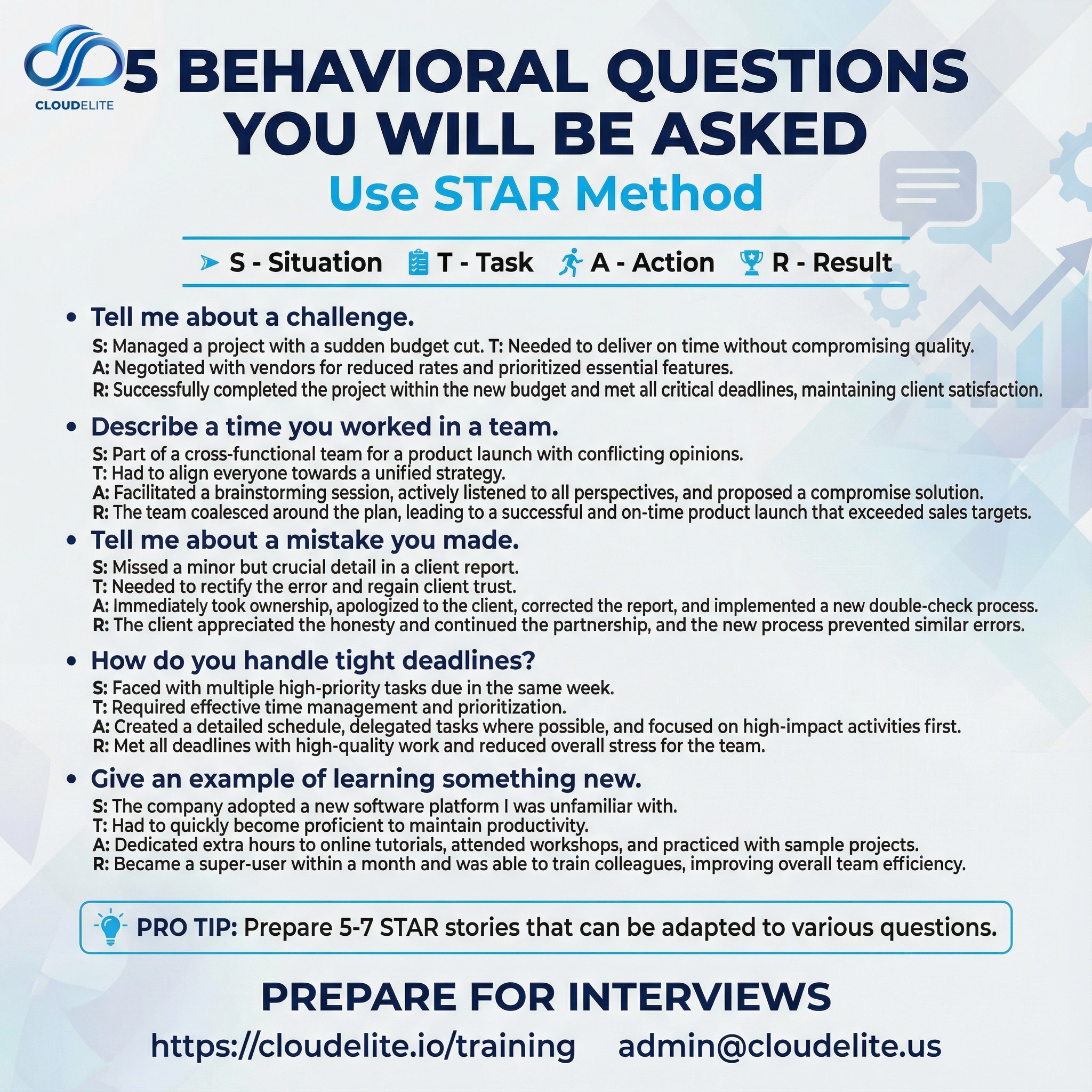
STAR method - a structured response framework for behavioral interview questions consisting of four components: Situation (context), Task (your responsibility), Action (what you specifically did), and Result (the measurable outcome).
The STAR method is not a secret. Hiring managers know it exists. Amazon explicitly trains its interviewers to evaluate STAR-formatted responses. Google, Microsoft, and Meta all use behavioral questions in their interview loops and expect structured answers. The method works not because it tricks the interviewer but because it forces you to deliver exactly the information they need to evaluate your competencies. Without structure, most candidates ramble, provide irrelevant detail, skip the outcome, or accidentally make the story about their team rather than themselves.
Why behavioral questions exist in the first place
Behavioral interviewing was developed by industrial psychologist Tom Janz in the early 1980s, building on the principle that past behavior is the best predictor of future behavior. Before behavioral interviewing became standard, most interview questions were hypothetical: "What would you do if..." The problem with hypothetical questions is that candidates give aspirational answers - what they would like to do - rather than evidence of what they actually have done.
Behavioral interviewing - an interview methodology based on the premise that a candidate's past actions in specific situations are the most reliable predictor of how they will behave in similar future situations.
Janz's research, published in the Journal of Applied Psychology in 1982, demonstrated that structured behavioral interviews had meaningfully higher predictive validity for job performance than unstructured interviews. This finding transformed corporate hiring practices over the following decades.
Amazon's Leadership Principles interview process is perhaps the most well-known implementation of behavioral interviewing at scale. Every Amazon interviewer is assigned specific Leadership Principles to evaluate, and every evaluation is based on behavioral evidence - specific examples from the candidate's past. An Amazon interviewer evaluating "Customer Obsession" is not interested in your philosophy about customer service. They want a concrete story about a time you went above and beyond for a customer, structured clearly enough for them to extract the relevant data points.
The most effective interviews are those where the candidate provides specific, detailed examples of past behavior. Hypothetical responses - "I would do X" - provide far less predictive value for actual job performance than accounts of what a candidate has actually done.
Breaking down each component of STAR
Situation: setting the scene in 2-3 sentences
The Situation component provides context. It tells the interviewer when and where this happened, what the broader circumstances were, and why this situation was notable. The most common mistake in the Situation is providing too much detail. You are not telling a complete story at this stage - you are establishing just enough context for the rest of the answer to make sense.
Good Situation example: "In my previous role as a DevOps engineer at a mid-size SaaS company, we had a production outage during our busiest month that affected approximately 5,000 customers. I was the on-call engineer when the alert fired."
Poor Situation example: "So, at my last job, we had this really complex microservices architecture, and we were using Kubernetes for orchestration, and we had about 15 microservices, and one of them was the authentication service which was written in Go, and..." (This is too much irrelevant detail before reaching the actual situation.)
Task: defining your specific responsibility
The Task component clarifies what specifically was expected of you. In team-based scenarios, this is where you distinguish your individual responsibility from the team's collective responsibility. Interviewers are evaluating you, not your team.
Good Task example: "As the on-call engineer, I was responsible for triaging the incident, coordinating the response, and restoring service within our four-hour SLA."
The Task component should take one to two sentences. If it takes longer, you are probably including Action elements prematurely.
Action: the core of your answer
The Action component is where most of the evaluation happens. This is where you describe exactly what you did - not what your team did, not what you would have done in hindsight, but what you actually did in the moment.
Effective Action descriptions:
- Use first-person singular ("I identified," "I decided," "I implemented") rather than "we"
- Describe your decision-making process, not just your actions
- Include specific tools, technologies, or methods you used
- Acknowledge obstacles you encountered and how you overcame them
- Show how you involved or led others when relevant, while keeping focus on your contributions
The Action section should be the longest part of your STAR response, taking approximately 60% of the total answer time.
Result: quantifiable outcomes
The Result component tells the interviewer what happened as a consequence of your actions. Strong results include:
- Measurable metrics ("reduced response time from 4 hours to 45 minutes")
- Business impact ("saved the company an estimated $50,000 in potential customer churn")
- Process improvements ("the runbook I created was adopted as the standard incident response procedure")
- Lessons learned (only if the interviewer specifically asks what you learned)
| STAR Component | Purpose | Time Allocation | Common Mistake |
|---|---|---|---|
| Situation | Provide context | 10-15% | Too much background detail |
| Task | Define your role | 10-15% | Confusing team goals with personal responsibility |
| Action | Show what you did | 50-60% | Using "we" instead of "I"; skipping decision rationale |
| Result | Demonstrate impact | 15-20% | Vague outcomes; no metrics; forgetting to state the result |
Preparing STAR stories before the interview
You cannot improvise STAR stories in real time under interview pressure. The candidates who sound natural and confident in behavioral interviews have prepared and rehearsed their stories in advance.
The story bank approach
Build a bank of 8-12 STAR stories that cover the most commonly assessed competencies:
- Leadership / taking initiative
- Conflict resolution / working with difficult people
- Failure / learning from mistakes
- Working under pressure / tight deadlines
- Customer focus / going above expectations
- Innovation / improving a process
- Data-driven decision making
- Cross-functional collaboration
Each story should be versatile enough to answer multiple types of questions with minor adjustments. A story about resolving a conflict with a teammate while under deadline pressure can answer questions about conflict resolution, working under pressure, and communication skills depending on which elements you emphasize.
Calibrating stories to the company
Before your interview, research which competencies the company prioritizes. Amazon publishes its 16 Leadership Principles publicly. Google evaluates "Googleyness" (collaboration, comfort with ambiguity) alongside technical skills. Microsoft emphasizes growth mindset - a concept championed by CEO Satya Nadella based on Carol Dweck's research at Stanford.
LinkedIn job postings often include specific competencies in the "preferred qualifications" section. If a posting mentions "experience influencing cross-functional teams," prepare a STAR story specifically demonstrating that competency.
The best candidates do not just answer the question that was asked. They answer with a story that clearly maps to the competency being evaluated, and that level of preparation is itself a signal of the kind of structured thinking hiring managers want in the role, a point echoed by Laszlo Bock, former SVP of People Operations at Google, in his book Work Rules!
Common behavioral questions mapped to STAR preparation
Amazon Leadership Principles questions
Amazon interviewers are trained to ask follow-up questions that drill deeper into each STAR component. Prepare for these follow-ups by knowing your stories in granular detail.
| Leadership Principle | Example Question | STAR Focus |
|---|---|---|
| Customer Obsession | "Tell me about a time you went beyond requirements for a customer" | Action: specific steps; Result: customer impact |
| Ownership | "Describe a time you took on something outside your job description" | Task: why you took it on; Action: what you did |
| Bias for Action | "Tell me about a decision you made with incomplete information" | Action: your reasoning process; Result: outcome |
| Disagree and Commit | "Describe a time you disagreed with a team decision but supported it" | Action: how you raised concerns; Result: what happened |
General behavioral questions with STAR mapping
"Tell me about your greatest professional failure" - Focus the Result on what you learned and how you applied that lesson subsequently. The interviewer is assessing self-awareness and growth, not looking for a confession.
"Describe a time you had to persuade someone who disagreed with you" - The Action should focus on your persuasion approach (data, empathy, compromise) not on proving you were right.
"Give an example of when you had to learn something quickly" - The Action should describe your learning method and the Task should establish why speed was necessary.
"Tell me about a time you improved a process" - The Result must include measurable improvement. "It was better afterward" is not sufficient. "Reduced deployment time from 2 hours to 15 minutes" is.
Delivery and pacing during the interview
Timing your responses
A complete STAR response should take 2-3 minutes. Shorter responses lack sufficient detail for evaluation. Longer responses lose the interviewer's attention and often indicate poor communication skills - which is itself a competency being evaluated.
Practice your stories with a timer. If a story consistently runs over 3 minutes, trim the Situation and Task components first. If it runs under 90 seconds, your Action component probably lacks sufficient detail about your decision-making process.
Handling follow-up questions
Behavioral interviewers will ask follow-up questions to test the depth of your stories:
- "What specifically was your role versus your team's role?" - They want more I-statements in your Action.
- "What would you do differently if you could do it again?" - They are testing self-reflection. Have a genuine answer prepared.
- "What was the quantitative impact?" - They want numbers. If you do not have exact numbers, provide honest estimates with context ("approximately 30% reduction based on the metrics we tracked").
- "How did that experience change your approach going forward?" - They want evidence of growth. Connect the story to your current practices.
Handling stories where you were not the hero
Not every behavioral question requires a success story. Questions about failure, conflict, and mistakes explicitly ask for situations that did not go perfectly. The key is demonstrating self-awareness, accountability, and learning.
A strong failure story follows the same STAR structure but adds a fifth element - Learning:
- Situation: The context
- Task: Your responsibility
- Action: What you did (including the mistake)
- Result: The negative outcome (stated honestly)
- Learning: What you changed as a result, with evidence that the change was effective
Netflix's culture document explicitly values "judgment" and "candor" - they want to hear about real mistakes because how candidates discuss failures reveals more about their character than how they discuss successes. The same principle applies at most mature technology companies.
Industry-specific behavioral interview patterns
Technology companies
Tech companies (Google, Meta, Amazon, Microsoft) typically allocate 1-2 rounds of a 4-6 round interview loop to behavioral questions. The remainder covers technical skills. Behavioral rounds at tech companies focus heavily on collaboration, ambiguity tolerance, and leadership potential.
Consulting firms
McKinsey, Deloitte, and Accenture emphasize client management, problem-solving under constraints, and influencing without authority. STAR stories for consulting interviews should demonstrate commercial awareness and stakeholder management.
Financial services
Goldman Sachs, JPMorgan, and similar firms focus on risk management, ethical decision-making, and attention to detail. STAR stories for financial services should include specific examples of identifying and mitigating risk.
| Industry | Top 3 Behavioral Competencies | STAR Story Emphasis |
|---|---|---|
| Technology | Collaboration, Innovation, Ownership | Action: technical decisions; Result: scalable impact |
| Consulting | Client management, Structured thinking, Influence | Action: stakeholder management; Result: client outcomes |
| Finance | Risk awareness, Ethics, Precision | Action: risk identification; Result: prevented losses |
Practice methods that build confidence
The mock interview approach
The most effective behavioral interview practice involves another person. Ask a friend, colleague, or mentor to conduct a mock behavioral interview using questions from your target company's known question list. Record the session if possible, and review your responses for:
- Clarity of the Situation setup
- Specificity of the Action description
- Presence of measurable Results
- Use of "I" versus "we"
- Total response time (target 2-3 minutes)
The written preparation method
Write out each STAR story in full before practicing verbal delivery. Writing forces precision that speaking does not. Many candidates discover during the writing process that their stories have gaps - they cannot articulate what they specifically did, or they cannot quantify the result. Better to discover these gaps during preparation than during the interview.
The Society for Human Resource Management (SHRM) recommends that candidates prepare written STAR frameworks for at least 8-10 stories and practice verbal delivery of each story at least three times before the interview. Candidates who prepare structured stories in advance tend to receive noticeably more favorable hiring recommendations than those who answer behavioral questions without preparation.
STAR for technical roles: bridging behavior and skills
Software engineering behavioral questions
For software engineering roles at companies like Google, Meta, and Microsoft, behavioral questions often blend technical context with interpersonal assessment. A question like "Tell me about a time you had to make a difficult technical tradeoff" requires both STAR structure and technical fluency.
Technical behavioral question - a behavioral interview question that requires the candidate to describe past technical decisions, trade-offs, or problem-solving approaches within the STAR framework, evaluated for both interpersonal competency and technical judgment.
When describing technical scenarios, include enough technical detail to demonstrate competence without overwhelming the interviewer with jargon. For example, referencing specific tools is appropriate: "I used kubectl logs to diagnose the pod crash loop" or "I analyzed the CloudWatch metrics to identify the bottleneck in our Lambda function." These references signal hands-on experience without turning the behavioral answer into a technical lecture.
Cloud and DevOps role examples
For cloud engineering and DevOps positions, behavioral questions frequently target incident management, system design decisions, and automation initiatives. Strong STAR stories for these roles reference specific platforms and services:
- "I migrated our CI/CD pipeline from Jenkins to GitHub Actions, reducing build times by 40%"
- "I redesigned our
AWSinfrastructure usingTerraformmodules, enabling the team to provision new environments in 15 minutes instead of 2 days" - "I implemented a chaos engineering practice using Netflix's
Chaos Monkeyprinciples that identified three critical single points of failure before they caused outages"
Daniel Pink, the author of Drive: The Surprising Truth About What Motivates Us and a researcher on workplace motivation, notes that the most compelling interview stories demonstrate intrinsic motivation - candidates who pursued improvements because they genuinely cared about the outcome, not because they were told to. When choosing which STAR stories to prepare for technical roles, prioritize examples where you took initiative rather than examples where you followed instructions.
Adapting STAR for panel interviews
In panel interviews, common at companies like Salesforce and Oracle, multiple interviewers evaluate different competencies simultaneously. Your STAR story might be evaluated by one panelist for technical judgment and by another for communication skills. This means your stories need to work on multiple levels.
Panel interview - an interview format where multiple interviewers simultaneously assess a candidate, each evaluating different competencies, requiring responses that demonstrate breadth across technical, interpersonal, and leadership dimensions.
The adaptation for panel interviews is subtle but important: after delivering your STAR response, briefly connect the story to broader themes. "That experience taught me the importance of clear communication during incidents - technical decisions are only as good as the team's ability to execute them." This sentence bridges the technical content for the non-technical panelist while reinforcing the competency focus for the technical evaluator.
See also: Company research strategies before interviews, Recruiter phone screen preparation, Technical interview preparation guides
References
- Janz, T. (1982). "Initial comparisons of patterned behavior description interviews versus unstructured interviews." Journal of Applied Psychology, 67(5), 577-580.
- Bock, L. (2015). Work Rules!: Insights from Inside Google That Will Transform How You Live and Lead. Twelve Publishing.
- Amazon.com. (2024). "Leadership Principles." Amazon Jobs website.
- Dweck, C. (2006). Mindset: The New Psychology of Success. Random House.
- Society for Human Resource Management. (2022). SHRM Talent Acquisition Survey. SHRM Research Institute.
- Huffcutt, A.I., & Arthur, W. (1994). "Hunter and Hunter (1984) revisited: Interview validity for entry-level jobs." Journal of Applied Psychology, 79(2), 184-190.
Frequently Asked Questions
How long should a STAR method response be in an interview?
A complete STAR response should take 2-3 minutes. Shorter responses lack sufficient detail for evaluation, while longer responses lose the interviewer’s attention. The Action component should take approximately 60% of the total response time.
How many STAR stories should I prepare before a behavioral interview?
Prepare 8-12 STAR stories covering common competencies including leadership, conflict resolution, failure, working under pressure, customer focus, and innovation. Each story should be versatile enough to answer multiple question types with minor adjustments to emphasis.
Do Amazon interviews require the STAR method specifically?
Amazon explicitly uses behavioral interviewing based on their 16 Leadership Principles. While they do not mandate the STAR format by name, their interviewers are trained to evaluate specific behavioral evidence, and the STAR structure is the most effective way to deliver the concrete examples they are looking for.