
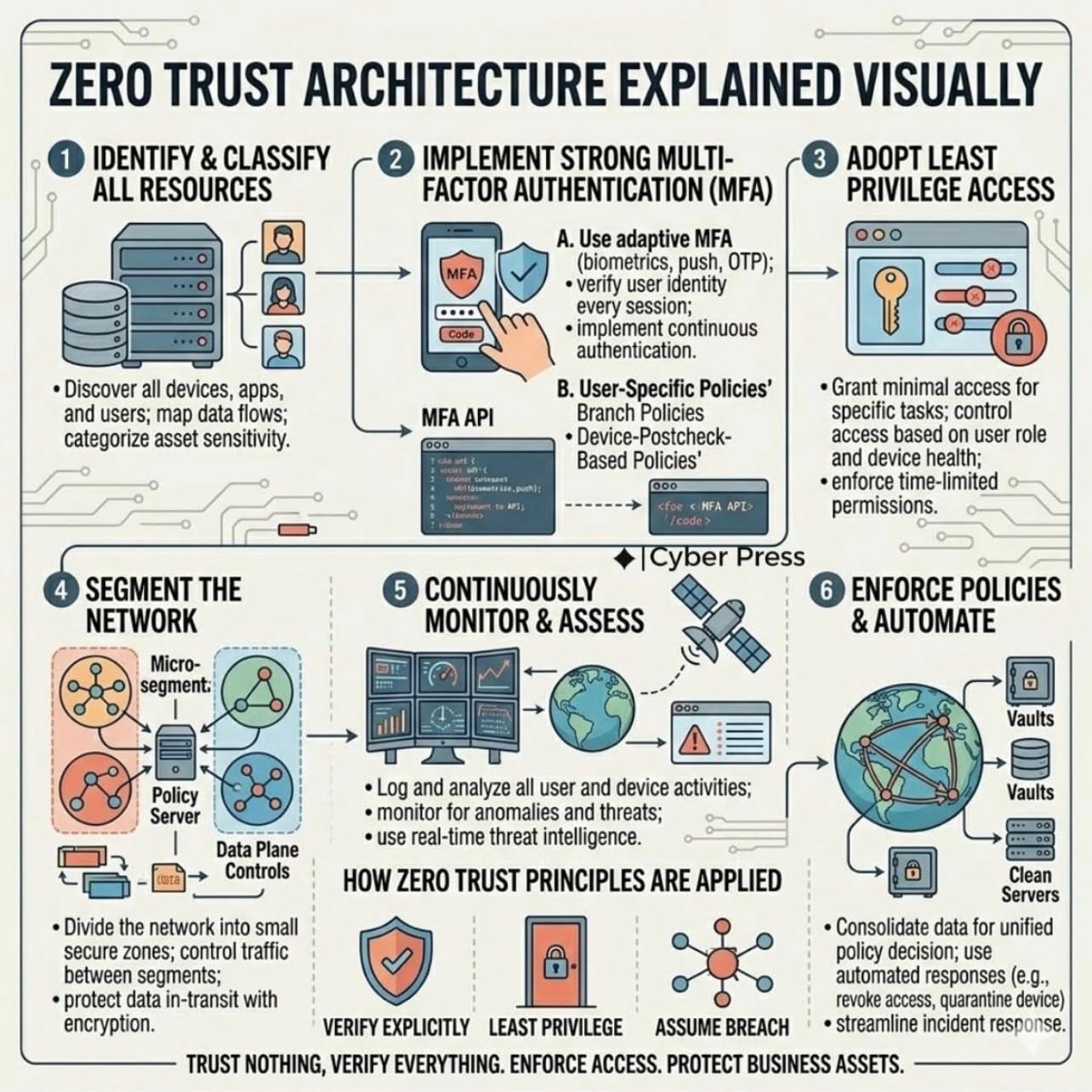
What is zero trust security architecture?
Zero trust security architecture is a security model based on the principle of "never trust, always verify" -- no user, device, or network connection is implicitly trusted regardless of its location inside or outside the corporate perimeter. Every access request is authenticated, authorized, and continuously validated based on identity, device health, location, and behavior signals before access is granted.
The zero trust security architecture model has transformed enterprise security, replacing the outdated castle-and-moat perimeter model where everyone inside the network was trusted by default. As workforces became distributed, cloud adoption accelerated, and attackers increasingly operated inside traditional perimeters, zero trust became the foundational security framework for modern organizations.
Zero trust is tested across multiple security certifications including CISSP, CCSP, AWS Security Specialty, AZ-500, and CompTIA CASP+. Understanding zero trust architecture is no longer a specialty topic -- it is a core competency expected of every security professional. This guide provides comprehensive coverage of zero trust principles, architecture components, and implementation approaches.
Zero Trust Foundational Principles
The Three Core Tenets
NIST SP 800-207 defines zero trust around three core principles:
Verify explicitly: Always authenticate and authorize based on all available data points. Never assume that because someone passed one authentication check, they should have access to everything.
Use least privilege access: Grant users and systems only the minimum permissions required for their current task. Limit blast radius when credentials are compromised.
Assume breach: Design security as if an attacker is already inside the environment. Segment networks, monitor everything, and minimize the damage from any single compromise.
Shift from Perimeter Security
Traditional perimeter security model:
- Firewall at the network edge separates "trusted" internal network from "untrusted" internet
- Users inside the network have broad access
- Focus on preventing intruders from entering
- Critical failure mode: Once inside, attackers move freely
Zero trust model:
- No network location is inherently trusted
- Every connection is evaluated on its merits (identity, device, context)
- Microsegmentation limits lateral movement
- Continuous monitoring detects anomalies in real time
"Zero trust is not a product -- it is an architectural philosophy. Organizations that approach it as 'we need to buy a zero trust solution' miss the point. Zero trust requires rethinking how access is granted, how networks are segmented, how identity is managed, and how security is monitored across the entire environment." -- NIST Zero Trust Architecture guidance
Zero Trust Architecture Components
Identity as the New Perimeter
Strong identity verification is the foundation of zero trust:
- Phishing-resistant MFA: Hardware security keys (FIDO2) or certificate-based authentication provide stronger protection than TOTP or SMS-based MFA
- Identity governance: Regularly reviewing access rights to ensure they remain appropriate (access reviews, certification campaigns)
- Privileged access management (PAM): Just-in-time access to administrative credentials, vaulting of privileged passwords, session recording
- Continuous authentication: Risk-based authentication that re-challenges users when behavioral signals suggest the session may be compromised
Device Trust
Zero trust requires knowing the security posture of devices requesting access:
| Device State | Typical Access | Examples |
|---|---|---|
| Fully managed, compliant | Full corporate access | Corporate laptop with Intune/Jamf, current patches, EDR |
| Managed, non-compliant | Restricted access or quarantine | Corporate device needing updates |
| BYOD, MAM-enrolled | App-level access only | Personal device with work apps via MAM |
| Unmanaged | No access or very restricted | Personal device without enrollment |
Device compliance policies evaluate:
- OS version and patch level
- Encryption status (disk encryption enabled)
- Security software (EDR agent installed and healthy)
- Screen lock and PIN requirements
- Jailbreak/root detection
Network Microsegmentation
Microsegmentation divides the network into small segments, each with its own access controls, so that compromising one segment does not provide access to adjacent segments:
- Host-based microsegmentation: Firewall rules applied at the workload level (regardless of network location)
- Software-defined perimeter (SDP): Creates per-user, per-session network connections authorized before communication begins
- Application-specific access: Users can reach only the specific application they need, not the entire server or network
Policy Enforcement and Decision Points
Zero trust policy engine evaluates access requests against policy:
- Policy Decision Point (PDP): Evaluates the access request against policy rules. Receives signals (identity, device, location, time, behavior) and makes an allow/deny decision.
- Policy Enforcement Point (PEP): Enforces the PDP's decision. Can be a network proxy, API gateway, application proxy, or cloud access security broker (CASB).
- Policy Information Point (PIP): Provides signals to the PDP (device compliance from MDM, user risk from Identity Protection, threat intelligence).
Zero Trust Maturity Model
CISA Zero Trust Maturity Model
The U.S. Cybersecurity and Infrastructure Security Agency (CISA) defines a Zero Trust Maturity Model with five pillars:
| Pillar | Focus | Maturity Stages |
|---|---|---|
| Identity | Who is accessing? | Traditional > Initial > Advanced > Optimal |
| Devices | What device is used? | Traditional > Initial > Advanced > Optimal |
| Networks | How is communication routed? | Traditional > Initial > Advanced > Optimal |
| Applications and Workloads | What applications are accessed? | Traditional > Initial > Advanced > Optimal |
| Data | What data is accessed? | Traditional > Initial > Advanced > Optimal |
Traditional stage: Password-only authentication, flat network with implicit trust, no device compliance enforcement.
Optimal stage: Phishing-resistant MFA, continuous behavioral analytics, automated threat response, data-centric access controls with sensitivity labels enforced in real time.
Vendor Implementations
Microsoft Zero Trust Architecture
Microsoft's Zero Trust guidance organizes implementation around three areas:
Workforce:
- Microsoft Entra ID for strong identity verification
- Microsoft Intune for device management and compliance
- Conditional Access policies for context-aware access decisions
Workload:
- Azure Firewall and NSGs for workload segmentation
- Microsoft Defender for Cloud for workload security monitoring
- Azure Policy for compliance enforcement
Workplace:
- Microsoft Defender for Endpoint for endpoint security
- Azure DDoS Protection and Azure Front Door for perimeter security
- Microsoft Sentinel for security monitoring
Google BeyondCorp
Google's BeyondCorp model (which inspired much modern zero trust thinking) moved access controls from the network perimeter to individual devices and users:
- Every device is verified (corporate-owned and BYOD treated equally)
- Users can work from any network (corporate, home, coffee shop) with the same access controls
- Application access is granted based on device certificate and user identity, not network location
- Access proxy terminates all connections and verifies credentials before proxying to backend
Cisco Zero Trust Architecture
Cisco's zero trust implementation covers:
- Workforce: Cisco Duo for MFA and device trust; Cisco ISE for network access control
- Workload: Cisco Tetration/Secure Workload for microsegmentation based on application behavior
- Workplace: Cisco SD-Access and TrustSec for automated network segmentation
Zero Trust for Certification Exams
Exam-Tested Zero Trust Concepts
| Concept | How It Appears on Exams |
|---|---|
| Least privilege | Scenario: User reports inability to access a resource. Is restricting access correct? (Yes, if they don't need it) |
| Assume breach | Scenario: Designing an architecture after a breach. Zero trust principles should guide segmentation. |
| Continuous verification | Scenario: User whose credentials were compromised. Zero trust would detect anomalous behavior and re-authenticate. |
| Microsegmentation | Scenario: Limiting lateral movement after initial compromise. Microsegmentation is the answer. |
| ZTNA vs. VPN | Scenario: Remote access options. ZTNA provides per-application access vs. VPN provides network-level access. |
ZTNA vs. Traditional VPN
| Aspect | Traditional VPN | ZTNA |
|---|---|---|
| Network access | Full network access after authentication | Per-application access only |
| Trust model | Trust the network connection | Trust the identity and device |
| Lateral movement risk | High (once connected, can reach anything) | Low (cannot reach unauthorized applications) |
| Performance | Traffic backhauled through VPN gateway | Direct connection to applications |
| User experience | Single tunnel for all traffic | Application-aware |
"The most common exam question about zero trust presents a scenario where an organization is concerned about lateral movement after a potential compromise and asks which architecture best addresses it. The answer is always microsegmentation or zero trust network access -- architectures that explicitly limit what a compromised credential or device can reach." -- Zero trust security certification community
Frequently Asked Questions
Is zero trust a product you can buy? Zero trust is an architectural philosophy and methodology, not a product. Vendors sell products that help organizations implement zero trust principles -- MFA products, ZTNA gateways, microsegmentation tools, CASB solutions, identity governance platforms -- but no single product provides complete zero trust. Organizations implement zero trust gradually by applying its principles to identity, devices, networks, applications, and data.
How long does it take to implement zero trust? Full zero trust implementation is a multi-year journey for most enterprises. CISA's Zero Trust Maturity Model recognizes that organizations move from Traditional through Initial, Advanced, and Optimal stages at different rates across different pillars. Pragmatic implementations start with the highest-value areas: strong MFA for all users (especially administrators), device compliance enforcement, and network microsegmentation for the most sensitive workloads.
Which certifications test zero trust most heavily? Zero trust is covered in CISSP (Security Architecture domain), CCSP (Cloud Security Architecture), CASP+ (Security Architecture domain), AZ-500 (Conditional Access and identity), AWS Security Specialty (security architecture design), and CISA. Security+ SY0-701 introduced zero trust as a new conceptual topic. SABSA and other enterprise architecture certifications also cover zero trust extensively.
References
- NIST. (2020). SP 800-207: Zero Trust Architecture. https://doi.org/10.6028/NIST.SP.800-207
- CISA. (2023). Zero Trust Maturity Model v2.0. https://www.cisa.gov/zero-trust-maturity-model
- Microsoft. (2025). Zero Trust Guidance Center. https://learn.microsoft.com/en-us/security/zero-trust/
- Google. (2014). BeyondCorp: A New Approach to Enterprise Security. USENIX ;login: Winter 2014, Vol. 39, No. 6.
- Kindervag, J. (2010). No More Chewy Centers: Introducing The Zero Trust Model Of Information Security. Forrester Research.
- Rose, S., Borchert, O., Mitchell, S., & Connelly, S. (2020). Zero Trust Architecture (NIST SP 800-207). National Institute of Standards and Technology. https://doi.org/10.6028/NIST.SP.800-207
Frequently Asked Questions
What is zero trust security architecture?
Zero trust is a security model based on ‘never trust, always verify’ where no user, device, or network connection is implicitly trusted regardless of location. Every access request is authenticated, authorized, and continuously validated based on identity, device health, location, and behavior signals.
Is zero trust a product you can buy?
Zero trust is an architectural philosophy, not a single product. Vendors sell products that help implement zero trust principles including MFA, ZTNA gateways, microsegmentation tools, CASB solutions, and identity governance platforms. No single product provides complete zero trust; organizations implement it gradually across multiple pillars.
Which certifications test zero trust most heavily?
Zero trust is covered in CISSP, CCSP, CASP+, AZ-500, AWS Security Specialty, and CISA. Security+ SY0-701 introduced zero trust as a new conceptual topic. The most exam-tested concepts are microsegmentation for lateral movement prevention, ZTNA vs. VPN comparisons, and least privilege access principles.