
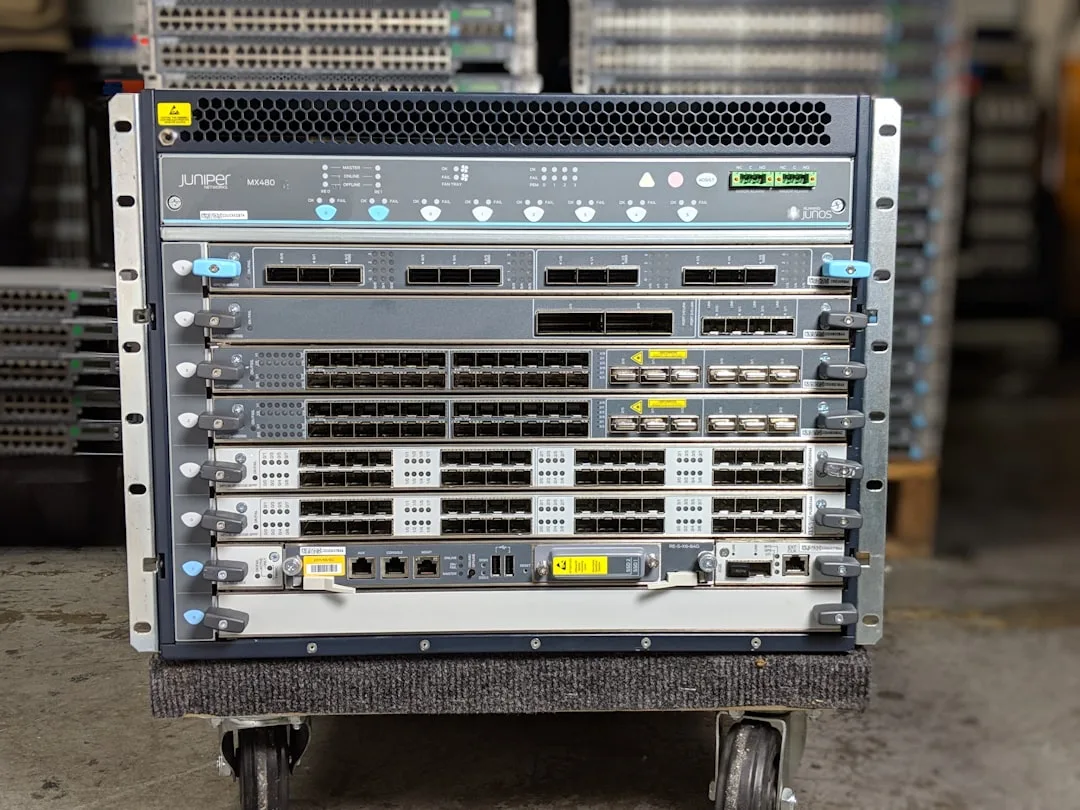
For candidates planning an associate-tier networking cert, the Cisco CCNA (200-301) and the Juniper JNCIA-Junos (JN0-105) are the two credible options. Cisco’s market dominance has historically made CCNA the default, but Juniper’s presence in service provider networks, cloud provider backbones, and high-performance enterprise environments keeps JNCIA-Junos relevant. The right pick depends on your target employer, your region, and whether you want Cisco-specific or Juniper-specific signaling.
This guide compares JNCIA-Junos and CCNA on exam structure, vendor ecosystem, salary data, preparation time, and career trajectory for 2026.
Side by Side Comparison
| Attribute | Juniper JNCIA-Junos (JN0-105) | Cisco CCNA (200-301) |
|---|---|---|
| Issuer | Juniper Networks | Cisco Systems |
| Tier | Associate | Associate |
| Exam fee (2026) | \(200 USD (discounted to \)100 during certain promotions) | $300 USD |
| Question count | 65 items | ~100 items |
| Exam time | 90 minutes | 120 minutes |
| Passing score | Not disclosed (est. 70%) | ~825 / 1000 (est. 82.5%) |
| Format | Multiple choice, multi-select | Multiple choice, drag and drop, simulations |
| Prerequisite | None | None |
| Validity | 3 years | 3 years |
| Retake policy | 14 days first, 30 days after second fail | 5 days first, 180 days after third |
JNCIA-Junos is cheaper. CCNA has a longer exam with more varied item types including live simulations. Both are 3-year validity.
What JNCIA-Junos Tests
JNCIA-Junos validates fundamental Junos OS operations. Domain coverage:
- Networking fundamentals (OSI, TCP/IP, subnetting)
- Junos OS basics (architecture, configuration, commit model)
- User interface navigation (CLI, J-Web)
- Configuration basics (hierarchies, commit, rollback)
- Operational monitoring and maintenance
- Routing fundamentals (static routes, OSPF basics)
- Routing policies and firewall filters
The exam focuses on Junos OS as the operational environment. Candidates learn Juniper’s unique commit-rollback configuration model, hierarchical configuration structure, and command syntax that differ meaningfully from Cisco IOS.
“Junos is not a reskin of IOS. The commit model, the configuration hierarchy, and the automation story are genuinely different. Candidates coming from Cisco need to unlearn some habits before JNCIA passes feel natural.” Chris Jones, Juniper consultant and trainer
What CCNA Tests
CCNA 200-301 covers Cisco-specific networking fundamentals. Domain weights:
| Domain | Weight |
|---|---|
| Network Fundamentals | 20% |
| Network Access | 20% |
| IP Connectivity | 25% |
| IP Services | 10% |
| Security Fundamentals | 15% |
| Automation and Programmability | 10% |
CCNA is broader and includes real Cisco IOS simulation items, Python automation intro, and REST API basics.
Market Reality: Cisco vs Juniper in 2026
Cisco dominates enterprise networking. Juniper holds strong positions in:
- Tier 1 and Tier 2 internet service providers (AT&T, Verizon, DT, NTT)
- Cloud provider backbones (particularly Microsoft Azure, Google Cloud, partial AWS)
- Financial services trading networks
- Research and education networks (Internet2, regional R&E networks)
- Some federal agencies (especially research-focused)
- Mission-critical infrastructure
For enterprise generalists, CCNA dominates. For service provider and cloud backbone roles, JNCIA-Junos opens doors CCNA does not specifically target.
Job Market Fit
Q1 2026 US listings:
| Filter | JNCIA preferred | CCNA preferred |
|---|---|---|
| Enterprise network engineer | Rare | Very high |
| Service provider network engineer | Very high | High |
| Cloud provider backbone roles | Very high | Moderate |
| Federal contractor | Moderate | Very high |
| MSP / IT services | Low | Very high |
| Data center engineer | Moderate | High |
Listings mentioning Juniper experience are roughly 15 to 20 percent of listings mentioning Cisco experience. The gap is narrower in service provider and cloud sectors.
Salary Data (2026 US)
Data from Dice, Levels.fyi, and vendor community surveys:
| Role | JNCIA holder | CCNA holder |
|---|---|---|
| Network admin (mid) | \(82,000-\)108,000 | \(85,000-\)108,000 |
| Network engineer (mid) | \(95,000-\)128,000 | \(95,000-\)125,000 |
| Service provider network engineer | \(110,000-\)145,000 | \(100,000-\)135,000 |
| Cloud backbone network engineer | \(130,000-\)180,000 | \(120,000-\)165,000 |
| Senior network engineer | \(130,000-\)175,000 | \(125,000-\)165,000 |
JNCIA holders in service provider and cloud backbone roles earn a modest premium because the talent pool is smaller. Enterprise-role compensation is roughly equal.
Preparation Time
JNCIA-Junos Prep
- 6 to 10 weeks at 10 hours per week for candidates with networking fundamentals
- 10 to 16 weeks for pure networking beginners
Study stack: Juniper Open Learning (free Junos Genius platform), Harry Reynolds and Doug Marschke books on Juniper, Juniper vLabs (free virtual labs), Junos Day One guides (free PDFs).
CCNA Prep
- 12 to 16 weeks at 12 hours per week for candidates with networking background
- 16 to 24 weeks for beginners
Study stack: Wendell Odom’s Official Cert Guide, Jeremy’s IT Lab YouTube series, Boson ExSim practice, Cisco Packet Tracer.
JNCIA-Junos prep is roughly 30 to 40 percent shorter than CCNA because the exam is narrower (fewer items, shorter time, no simulation items).
Decision Matrix
Take JNCIA-Junos If
- Your target employer is a service provider (ISP, cloud backbone)
- You work at a Juniper shop currently
- You want a vendor-specific cert with less competition
- Your target role is cloud backbone or SP core engineer
- You value Junos’s commit-rollback model and automation story
Take CCNA If
- Your target employer is enterprise, federal, MSP, or general IT
- Your employer runs Cisco gear
- You want the credential with maximum market recognition
- You plan to pursue CCNP later
- You target the broadest job pool at associate tier
Take Both If
- You work in multivendor environments (consulting, large enterprise, SP)
- You want maximum vendor flexibility
- Your career trajectory spans enterprise and service provider work
- You have 20 to 26 weeks of combined prep time
Juniper Progression Path
JNCIA-Junos is the entry point for Juniper’s track. The progression:
- JNCIA-Junos (associate foundation)
- JNCIS-ENT or JNCIS-SP (specialist, enterprise or service provider track)
- JNCIP-ENT or JNCIP-SP (professional)
- JNCIE-ENT or JNCIE-SP (expert, lab based)
Juniper’s tracks split between enterprise (ENT) and service provider (SP). Candidates picking the SP track typically target ISPs, cloud backbones, and mission-critical core network roles.
Cisco Progression Path
CCNA leads to CCNP (with concentration) then optionally CCIE. Details in the CCNA vs CCNP comparison at Pass4Sure.
Content Overlap
Roughly 60 percent fundamental network theory overlaps (OSI, TCP/IP, subnetting, routing concepts). Vendor-specific content does not transfer:
- CLI syntax
- Configuration hierarchy (Juniper hierarchical vs Cisco flat)
- Commit model (Juniper stages changes; Cisco applies immediately)
- Routing protocol implementation details
- Troubleshooting commands
Candidates with CCNA pass can add JNCIA-Junos in 4 to 6 weeks. Candidates with JNCIA can add CCNA in 8 to 10 weeks because CCNA’s simulation items require dedicated IOS practice.
Exam Format Differences
JNCIA-Junos is multi-choice only. No simulations. No drag-and-drop in most versions. Candidates who prefer knowledge-recognition format find JNCIA more comfortable.
CCNA includes real simulations requiring live CLI configuration. Candidates who have not practiced IOS commands fail simulation items regardless of theoretical knowledge.
Recertification
JNCIA-Junos
- 3-year cycle
- Renewal via exam retake or higher Juniper cert
- No continuing education program; straightforward retake or upskill
CCNA
- 3-year cycle
- CE credits program or retake or higher Cisco cert
- 30 CE credits required for associate-level renewal
Cross Domain Considerations
Network engineering roles at both vendor camps require strong documentation. The technical writing templates at Evolang cover runbook and change management structures useful for network engineers.
For candidates moving into consulting or partner work, entity structure matters. The business formation guides at Corpy cover LLC setup for US-based network consultants.
Study focus matters for both. The productivity environment coverage at Down Under Cafe supports the lab-heavy study sessions both tracks demand. For spaced-recall on command syntax (which differs meaningfully between IOS and Junos), the study protocols at When Notes Fly work well.
Candidates assessing spatial and procedural cognitive fit for network engineering can use the cognitive style diagnostics at What’s Your IQ for self-assessment.
Related P4S Coverage
For candidates choosing between CompTIA Network+ and CCNA, see the Network+ vs CCNA comparison at Pass4Sure. For candidates planning CCNA to CCNP progression, see the CCNA vs CCNP timing comparison.
Candidates maintaining credentials on LinkedIn should use the QR code utilities at QR Bar Code for scannable verification links.
Common Mistakes
- Taking JNCIA-Junos in an enterprise-dominated market. The credential is less recognized outside Juniper-specific shops.
- Treating Junos CLI as IOS with different syntax. The commit model and hierarchy require different mental models.
- Using outdated Juniper material from pre-JN0-104⁄105 era. Blueprint refreshes have happened.
- Skipping vLabs. Hands-on Junos practice via Juniper’s free vLabs is essential for JNCIA prep.
- Overestimating Juniper demand in local markets. Check actual job ads before committing.
Quick Decision Framework
- Is your target employer enterprise? CCNA.
- Is your target employer SP, cloud backbone, or Juniper shop? JNCIA-Junos.
- Are you in a market with significant Juniper demand (DC metro, SF Bay, NYC, Seattle)? JNCIA can be viable.
- Are you in a market with minimal Juniper demand (most of US)? CCNA is the safer pick.
- Multi-vendor career ambition? Consider both over 18 to 24 months.
Cost Comparison
| Element | JNCIA-Junos | CCNA |
|---|---|---|
| Exam | \(200 (sometimes \)100 promo) | $300 |
| Study materials | \(50-\)150 | \(100-\)400 |
| Lab environment | Free (vLabs, EVE-NG with images) | Free (Packet Tracer) or paid (CML) |
| Total first-year | ~\(250-\)400 | ~\(400-\)700 |
JNCIA-Junos has lower cost. CCNA has higher cost but broader recognition.
Regional Notes
- United States: Cisco dominates; Juniper niche in specific sectors
- European Union: Cisco dominates; Juniper strong in certain carriers (DT, Swisscom, OTE)
- Asia Pacific: Cisco dominates; Juniper strong in NTT, SingTel, others
- India: Cisco dominates; Juniper niche in select GCC offices
Candidates in markets with minimal Juniper presence should default to CCNA.
References
- Juniper Networks. JNCIA-Junos Certification (JN0-105). Juniper, 2024. https://www.juniper.net/us/en/training/certifications/
- Cisco. CCNA 200-301 Exam Topics. Cisco Learning Network, 2024. https://learningnetwork.cisco.com/s/ccna-exam-topics
- Dice. 2026 Tech Salary Report. Dice Insights, 2026. https://www.dice.com/technologists/ebooks/tech-salary-report/
- US Bureau of Labor Statistics. Network and Computer Systems Administrators. BLS, 2026. https://www.bls.gov/ooh/computer-and-information-technology/network-and-computer-systems-administrators.htm
- Juniper Networks. Juniper Open Learning Platform. Juniper, 2024.
- Reynolds, Harry, Doug Marschke. Junos Enterprise Routing. O’Reilly Media, 2011.
- IHS Markit. Routing Market Share Report. IHS Markit, 2024.
- Cisco Learning Network. CCNA Recertification Policy. Cisco, 2024.
Frequently Asked Questions
Is Juniper certification worth it outside service provider roles?
Usually not in enterprise markets. Cisco dominates enterprise networking and JNCIA recognition outside service provider, cloud backbone, and specific Juniper-heavy sectors is limited. Candidates in enterprise-dominated markets should default to CCNA.
How much easier is JNCIA-Junos than CCNA?
Measurably shorter prep time, narrower content, and no simulation items make JNCIA-Junos the lighter lift. Prep time is roughly 30 to 40 percent less than CCNA. The tradeoff is narrower market recognition.
Does JNCIA require hands-on lab practice?
Recommended but less intensive than CCNA. Juniper’s free vLabs provide virtual devices for practice. JNCIA has no simulation items on the exam, so hands-on practice is for concept reinforcement rather than exam readiness.
Can I translate CCNA knowledge directly to JNCIA?
Concepts transfer, vendor specifics do not. Junos hierarchical configuration, commit-rollback model, and CLI syntax differ meaningfully from Cisco IOS. Plan 4 to 6 weeks of Junos-specific study even with recent CCNA pass.
Is Juniper cheaper overall than Cisco for certs?
Yes, modestly. JNCIA at \(200 (sometimes \)100 promo) is cheaper than CCNA at $300. Higher tier Juniper certs are priced similarly to Cisco equivalents. Total career-ladder cost is roughly comparable for full progression.
Should I get JNCIA if I want to work at a cloud provider?
Possibly. Google Cloud and Microsoft Azure run Juniper in parts of their backbone. AWS uses a mix with custom Broadcom-based hardware. Cloud backbone network engineer roles sometimes specifically list Juniper experience. Enterprise cloud engineer roles do not.
How does JNCIA progression compare to CCNP?
Juniper’s next tier is JNCIS-ENT (enterprise) or JNCIS-SP (service provider), then JNCIP, then JNCIE with a hands-on lab. CCNP has a core+concentration structure. Both take 24 to 36 weeks of additional prep beyond associate tier. Costs are comparable.