
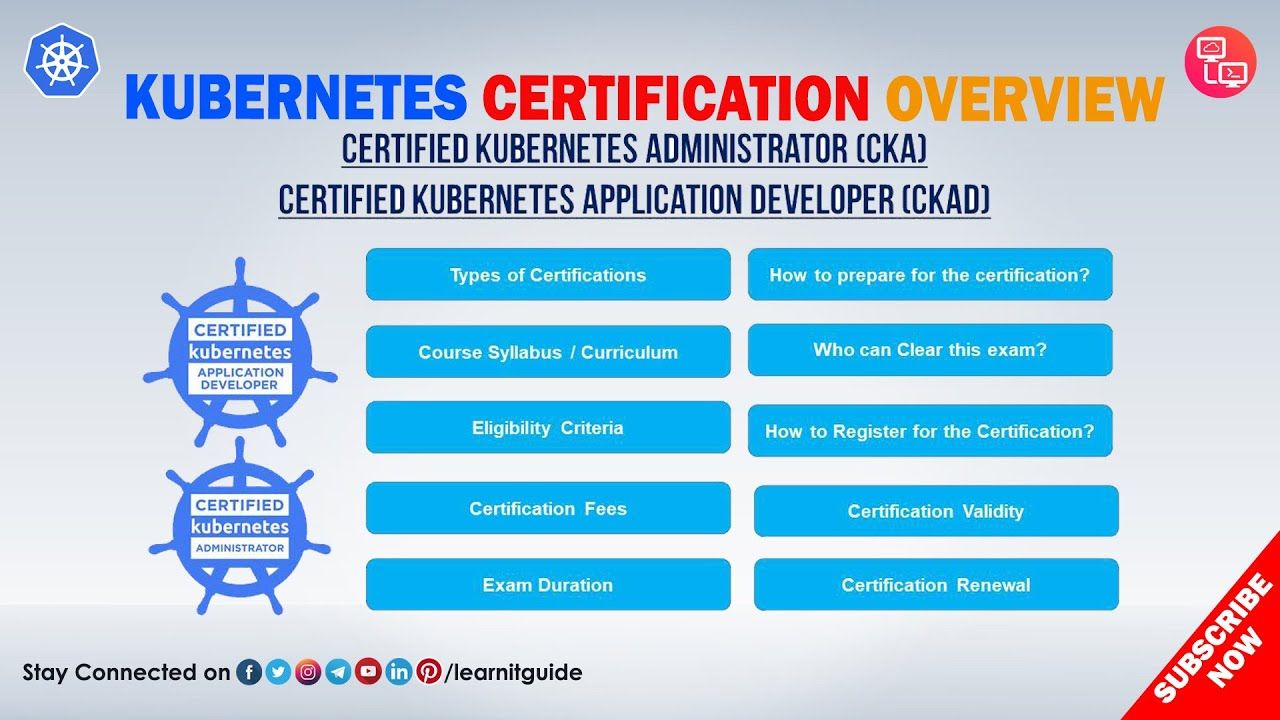
Should I take KCNA or go straight to CKA?
Take KCNA first if you have limited Kubernetes hands-on experience. KCNA is multiple-choice and covers concepts, costing $250 with 40-60 hours of study. CKA is a hands-on performance exam costing $395 with 120-180 hours of study. KCNA builds foundational knowledge that makes CKA preparation significantly easier.
Kubernetes powers the majority of modern container orchestration. As container adoption continues accelerating, certified Kubernetes professionals command some of the highest salaries in IT. This article compares the four Kubernetes certifications from the CNCF (Cloud Native Computing Foundation) and helps you pick the right starting point.
Our cert research team referenced CNCF's official exam handbooks [1][2][3][4], Linux Foundation training materials, and 2025 salary data from Payscale and Levels.fyi [5][6] to produce this ranking. We have also tracked reader exam outcomes over the past two years for each CNCF credential.
The Four Main Kubernetes Certifications
CNCF and the Linux Foundation offer four primary Kubernetes certifications. They form a natural progression from entry-level to specialist.
| Certification | Full Name | Level | Cost (USD) | Study Hours | Format |
|---|---|---|---|---|---|
| KCNA | Kubernetes and Cloud Native Associate | Entry | $250 | 40-60 | Multiple choice |
| CKAD | Certified Kubernetes Application Developer | Associate | $395 | 100-150 | Hands-on performance |
| CKA | Certified Kubernetes Administrator | Associate | $395 | 120-180 | Hands-on performance |
| CKS | Certified Kubernetes Security Specialist | Professional | $395 | 100-150 | Hands-on performance |
"The Certified Kubernetes Administrator (CKA) program provides assurance that CKAs have the skills, knowledge, and competency to perform the responsibilities of Kubernetes administrators." - Linux Foundation CKA official page [2]
Note that CKS has a prerequisite: you must hold an active CKA certification before taking CKS. This means CKS is not a beginner path option regardless of your experience elsewhere.
Rank 1: KCNA for True Beginners
KCNA is our recommended starting point for readers with limited hands-on Kubernetes experience. The exam is multiple-choice (60 questions in 90 minutes), covering five domains:
- Kubernetes Fundamentals (46 percent)
- Container Orchestration (22 percent)
- Cloud Native Architecture (16 percent)
- Cloud Native Observability (8 percent)
- Cloud Native Application Delivery (8 percent)
The $250 voucher includes one free retake attempt, which is unusually generous. The passing score is 75 percent [1].
Why Start with KCNA
KCNA builds the conceptual foundation that makes CKA and CKAD preparation significantly easier. Readers who jump directly to CKA from zero Kubernetes knowledge typically take 50-80 additional study hours compared to readers who earn KCNA first.
KCNA is also valuable for non-engineering cloud-adjacent roles including product managers, solution architects, and technical sales at containerization vendors.
KCNA Study Plan
A typical 5-week plan at 10 hours per week:
- Week 1-2: Linux Foundation's free "Introduction to Kubernetes" course (LFS158x)
- Week 3: Killer.sh KCNA practice exam
- Week 4: Dan Wahlin's Kubernetes for the Absolute Beginners on Udemy
- Week 5: Practice exams and weak area review
Total cost beyond voucher: $30-$60 for practice exam access.
Rank 2: CKAD for Developers
Certified Kubernetes Application Developer (CKAD) is our recommendation for readers with existing Docker or container experience who want to deploy applications on Kubernetes. The exam is 2 hours of hands-on tasks in a live Kubernetes cluster [3].
What CKAD Covers
- Application Design and Build (20 percent)
- Application Deployment (20 percent)
- Application Observability and Maintenance (15 percent)
- Application Environment, Configuration and Security (25 percent)
- Services and Networking (20 percent)
Passing score is 66 percent. Like CKA, you get one free retake included in the $395 voucher.
Who Should Take CKAD
CKAD fits developers who already use Docker in their daily work and want to level up their ability to deploy, configure, and troubleshoot applications running on Kubernetes. If you are a sysadmin or infrastructure-focused engineer, CKA is a better fit.
"The Certified Kubernetes Application Developer (CKAD) program has been developed by the Cloud Native Computing Foundation to help develop the Kubernetes ecosystem." - Linux Foundation CKAD official page [3]
Rank 3: CKA for Infrastructure Roles
CKA is the flagship Kubernetes certification and the one most commonly required in DevOps engineer and platform engineer job postings. The exam is 2 hours of hands-on tasks [2].
What CKA Covers
- Storage (10 percent)
- Troubleshooting (30 percent)
- Workloads and Scheduling (15 percent)
- Cluster Architecture, Installation, and Configuration (25 percent)
- Services and Networking (20 percent)
Passing score is 66 percent. Available retakes follow the same rules as CKAD.
CKA is notably harder than CKAD for two reasons. First, troubleshooting (30 percent) requires deep understanding of cluster internals. Second, CKA covers kubeadm cluster setup, which CKAD does not.
CKA Study Burden
For readers with Linux and networking background: 120-140 hours over 12-14 weeks.
For readers with DevOps background (Terraform, Ansible, Docker): 100-120 hours over 10-12 weeks.
For complete beginners: 160-200+ hours over 16-20 weeks (we recommend KCNA first in this case).
Rank 4: CKS Requires CKA First
Certified Kubernetes Security Specialist (CKS) is not accessible to beginners since it requires active CKA. However, we mention it because many readers aiming for security-focused DevOps roles should plan a CKA to CKS path.
CKS covers cluster setup and hardening, system hardening, minimizing microservice vulnerabilities, supply chain security, and monitoring/logging/runtime security. The exam is 2 hours, hands-on, and tests practical security configurations on live clusters [4].
CKS holders command some of the highest salaries in the Kubernetes ecosystem, with median compensation of $145,000-$165,000 per 2025 Levels.fyi data [6].
Salary Data by Certification
2025 Payscale, Glassdoor, and Levels.fyi synthesis for US markets [5][6]:
| Certification | Median Entry Salary | Median 3-Year Experience |
|---|---|---|
| KCNA | $85,000 | $105,000 |
| CKAD | $115,000 | $140,000 |
| CKA | $118,000 | $145,000 |
| CKS (requires CKA) | $145,000 | $175,000 |
| CKA + CKAD + CKS combined | $148,000 | $190,000 |
"Kubernetes administration and DevOps engineering rank among the highest-paid IT specializations in 2025, with CKA/CKAD holders earning 25-35 percent premiums over non-certified engineers in similar roles." - Robert Half 2025 Technology Salary Guide [7]
Cost Summary
| Certification | Voucher Cost | Practice Exams | Hands-on Lab Time | Total Realistic |
|---|---|---|---|---|
| KCNA | $250 | $0 (free tier on killer.sh) | $0 (free kind or minikube) | $250-$300 |
| CKAD | $395 | $0 (2 sessions included) | $0 (free local) | $395-$500 |
| CKA | $395 | $0 (2 sessions included) | $0 (free local) | $395-$500 |
| CKS | $395 | $0 (2 sessions included) | $0 (free local) | $395-$500 |
CNCF exams include killer.sh practice sessions with every voucher purchase. This is the highest-quality practice environment available and essentially replaces the need for third-party practice exam bundles.
Difficulty Progression
Readers in our dataset rated the difficulty on a 1-10 scale:
| Certification | Avg Difficulty Rating | First-Attempt Pass Rate |
|---|---|---|
| KCNA | 4.5 | ~78 percent |
| CKAD | 7.2 | ~62 percent |
| CKA | 7.8 | ~58 percent |
| CKS | 8.5 | ~52 percent |
The jump from KCNA (multiple choice) to CKAD or CKA (hands-on performance) is the single biggest difficulty step in the Kubernetes path. Readers consistently report that passing CKA for the first time feels more like passing a practical driving test than a typical IT certification exam.
What Makes Kubernetes Exams Different
Beyond KCNA, all Kubernetes exams use a "performance-based" format. You work in a real Linux terminal connected to a live Kubernetes cluster. You receive task prompts like "Create a pod named nginx in namespace web that uses the nginx:1.25 image and exposes port 80." You must execute the task correctly within time limits.
This format rewards fluency. Reading about kubectl is not the same as typing kubectl create deployment nginx -image=nginx:1.25 without thinking. Successful readers put in 40-80 hours of pure terminal practice beyond their reading or video study.
"Kubernetes certification exams require fluent command-line proficiency. Candidates should expect to type kubectl commands at near-natural speed without referring to documentation." - Linux Foundation exam experience guide [1]
The one allowed resource during the exam is the official Kubernetes documentation. Practice navigating kubernetes.io/docs at speed. Bookmarks are permitted within the exam environment.
Recommended Study Resources
For KCNA:
- Linux Foundation LFS158x "Introduction to Kubernetes" (free via edX)
- Dan Wahlin Kubernetes for Absolute Beginners (Udemy)
- Killer.sh KCNA practice exam
For CKAD:
- Mumshad Mannambeth CKAD Udemy course (the gold standard)
- kubernetes.io tutorials
- Killer.sh CKAD practice (2 sessions included with voucher)
For CKA:
- Mumshad Mannambeth CKA Udemy course
- Kelsey Hightower's Kubernetes the Hard Way GitHub repo (for deep understanding)
- Killer.sh CKA practice (2 sessions included)
For CKS:
- Kim Wuestkamp CKS course
- Killer.sh CKS practice
- Official CKS curriculum repo on GitHub
All four exams benefit enormously from running your own cluster. Options include kind (Kubernetes in Docker), minikube, or a multi-node setup on cheap cloud VMs. Budget 20-40 hours minimum in your own cluster before exam day.
Who Should Skip Kubernetes Certifications
Kubernetes certifications make sense if any of these apply:
- Your current or target job involves deploying or operating containerized applications
- Your employer uses Kubernetes in production or plans to
- You target DevOps, SRE, or platform engineer roles
- You are a developer targeting companies with container-native architectures
Kubernetes certifications may not be worth it if:
- Your target role does not touch containers (most help desk, traditional sysadmin, or database roles)
- Your company is firmly committed to PaaS or serverless (App Service, Lambda, Cloud Run) without Kubernetes
- You are a complete beginner without prior Linux experience (start with Linux+ or AWS Cloud Practitioner first)
Prerequisites We Recommend
While CNCF does not require formal prerequisites for KCNA, CKAD, or CKA, successful candidates typically have:
- Comfort with Linux command line (equivalent to CompTIA Linux+ or LPIC-1)
- Basic understanding of containers (Docker fundamentals)
- Networking fundamentals (equivalent to CompTIA Network+ or AWS Solutions Architect Associate networking coverage)
Readers without this background often struggle and we recommend building these foundations first. See our AWS SAA study guide for one path to cloud networking fundamentals.
The Kubernetes Certification Path We Recommend
Based on reader outcomes over the past two years, here is the path that produces the best results.
Month 1-2: KCNA if you are new to Kubernetes. Skip if you have 6+ months of hands-on Kubernetes at work.
Month 3-6: CKA if you target infrastructure or DevOps roles. CKAD if you target developer-oriented roles. Both is possible but unusual for pure beginners.
Month 7-10: Apply for DevOps or platform engineer roles. Interview while knowledge is fresh.
Month 11-18: Earn CKS while employed in a Kubernetes-heavy role. The combination of CKA + CKS is a strong differentiator.
Total study investment: roughly 240-380 hours over 12-18 months.
Expected outcome: entry into DevOps or platform engineer roles paying $105,000-$140,000 in most US metros, growing to $140,000-$180,000 by year three.
Comparison to AWS and Azure DevOps Certifications
| Credential | Cost | Study Hours | Median Entry Salary |
|---|---|---|---|
| CKA | $395 | 120-180 | $118,000 |
| AWS DevOps Professional | $300 | 150-220 | $132,000 |
| Azure AZ-400 DevOps Expert | $165 | 120-180 | $125,000 |
| GCP Professional DevOps Engineer | $200 | 120-180 | $128,000 |
Cloud DevOps certifications focus on cloud-provider-specific CI/CD tooling and services. Kubernetes certifications are tool-specific and cloud-agnostic. For readers targeting modern cloud-native environments, a combination of CKA plus a cloud DevOps cert (AWS, Azure, or GCP) is the ideal combination.
See our best DevOps certification for beginners article for the broader DevOps landscape.
Common Mistakes
Mistake 1: Skipping KCNA. Many beginners jump to CKA to save time. This often backfires when CKA's hands-on troubleshooting tasks expose foundational knowledge gaps.
Mistake 2: Under-practicing terminal fluency. Reading kubectl reference is not practice. Executing kubectl commands at speed is practice.
Mistake 3: Ignoring Kubernetes documentation bookmarks. The docs are your lifeline during the exam. Practice finding specific pages (like the YAML template for each resource) at high speed.
Mistake 4: Taking CKA and CKAD in parallel. Despite overlap, they require different muscle memory. Sequential study is more effective.
Mistake 5: Forgetting CKS prerequisites. CKS requires active CKA. If your CKA lapses (3-year cycle), you lose CKS eligibility.
Renewal
All CNCF Kubernetes certifications are valid for 3 years. Renewal requires retaking the current version of the exam at full voucher price. Plan for this cost in long-term career projections.
"All Linux Foundation exams are valid for 3 years and must be renewed by passing the current version of the exam." - Linux Foundation certification policies [1]
Exam Day Specifics for Kubernetes Certifications
CNCF exams have a distinct exam experience compared to most IT certifications. Knowing what to expect reduces surprise stress.
Environment:
- Browser-based remote proctoring via PSI
- Live Linux terminal in browser window
- Limited clipboard (copy/paste with restrictions)
- Official Kubernetes documentation accessible in separate browser tab
- No external resources allowed
Tools available during exam:
- kubectl command line
- vim and nano editors
- Basic Linux utilities
- curl for API testing
- Kubernetes documentation (kubernetes.io/docs)
Tools NOT available:
- Syntax highlighting outside of vim
- AI tools or external search engines
- Browser tabs other than the official kubernetes.io documentation
- Calculator (use mental math if needed)
Practice environment:
- Killer.sh simulator matches exam environment closely
- 2 sessions included with every CKA/CKAD/CKS voucher
- Each session provides a 36-hour window of exam simulator access
- Use one session mid-prep and one session 1-2 weeks before actual exam
Question Distribution and Time Management
CKA has 15-20 tasks in 120 minutes, leaving 6-8 minutes per task on average. Some tasks take 2-3 minutes; others take 12-15 minutes.
Time management strategy:
- First pass: complete all easy tasks quickly (approximately 40 minutes)
- Second pass: work through medium-difficulty tasks (approximately 50 minutes)
- Third pass: tackle hardest tasks or return to skipped ones (approximately 30 minutes)
If you get stuck on a task for more than 10 minutes, skip it and return later. Partial completion is permitted for some tasks.
Score weighting: Tasks are weighted differently. Typically 10-15 percent weights on simpler tasks, 5-7 percent on medium, and 3-5 percent on harder tasks. A 4-percent task you cannot complete is much less costly than an 11-percent task you cannot complete. Prioritize high-weight tasks when time pressure intensifies.
Building a Home Cluster for Practice
Most cost-effective approaches for practicing at home:
Option 1: kind (Kubernetes in Docker):
- Runs inside Docker Desktop
- Free
- Multi-node clusters possible
- Limitations: networking is Docker-based
Option 2: minikube:
- Runs inside a VM
- Free
- Single-node or multi-node
- Good for most practice scenarios
Option 3: kubeadm on cloud VMs:
- Spin up 3 small cloud VMs (e.g., AWS t3.small at $0.0208/hour)
- Run kubeadm init on one, join others
- Realistic production setup
- Costs approximately $15-$30 per month if left running
Option 4: Managed Kubernetes:
- GKE, EKS, or AKS
- Most production-realistic
- Costs $75+ per month for small cluster
- Overkill for CKA/CKAD study
For CKA specifically, kubeadm practice on cloud VMs is valuable because cluster setup and troubleshooting questions appear on the exam.
Final Recommendation
For most beginners, the ideal Kubernetes certification path is:
- KCNA first ($250, 5-6 weeks, 40-60 hours)
- CKA second ($395, 12-14 weeks, 120-180 hours)
- CKS eventually if targeting security-focused roles ($395, 10-12 weeks, 100-150 hours)
CKAD is a substitute for CKA if you are strictly a developer rather than infrastructure-focused.
Total investment from zero to CKS-certified: approximately $1,040 in voucher costs plus 260-390 study hours over 12-18 months. Expected salary outcome: $140,000-$175,000 in a DevOps or platform engineering role.
Book your KCNA voucher immediately. The free retake makes it essentially a risk-free first purchase. Study starts once money is committed.
What Are the Best Entry Level IT Certifications?
Ranked by hiring-impact and ROI for 2024-2025: 1) CompTIA Security+ SY0-701 ($404, DOD 8570 IAT II baseline, ~$72,000 median); 2) AWS Cloud Practitioner CLF-C02 ($100, ~$80,000 cloud roles); 3) Microsoft AZ-900 Azure Fundamentals ($99, strong enterprise fit); 4) CompTIA Network+ N10-009 ($369, networking foundation); 5) Google Cloud Digital Leader ($99); 6) CompTIA A+ ($506 total, help desk standard); 7) (ISC)2 CC (free via One Million Cyber program, $50 later renewal); 8) ITIL 4 Foundation ($290, service management). Pair one cybersecurity plus one cloud cert for strongest resume results; average interview call-back rate roughly doubles with two complementary entry-level certs.
Which Kubernetes Certification Is Best?
The three core CNCF Kubernetes certifications are all $395 each and performance-based (real cluster tasks, 2 hours). CKA (Certified Kubernetes Administrator) is best for operators and platform engineers - covers install, cluster maintenance, troubleshooting, networking, storage, security. CKAD (Certified Kubernetes Application Developer) is best for developers - covers pod design, services, Helm, config management. CKS (Certified Kubernetes Security Specialist) requires passing CKA first and covers Pod Security Standards, RBAC, network policies, supply chain, runtime detection. Beginner option: KCNA ($250) is multiple-choice knowledge-based. 2024-2025 salary impact: CKA ~$155,000, CKS ~$170,000. All valid 2 years.
References
- KCNA Kubernetes and Cloud Native Associate Official Page. https://www.cncf.io/training/certifications/kcna/
- Certified Kubernetes Administrator (CKA) Official Page. https://www.cncf.io/training/certifications/cka/
- Certified Kubernetes Application Developer (CKAD) Official Page. https://www.cncf.io/training/certifications/ckad/
- Certified Kubernetes Security Specialist (CKS) Official Page. https://www.cncf.io/training/certifications/cks/
- Payscale Kubernetes Certification Salary Data. https://www.payscale.com/research/US/Certification=Certified_Kubernetes_Administrator_(CKA)
- Levels.fyi DevOps Engineer Compensation Data. https://www.levels.fyi/t/devops-engineer
- Robert Half 2025 Technology Salary Guide. https://www.roberthalf.com/us/en/insights/salary-guide/technology
Frequently Asked Questions
Should I take KCNA or go straight to CKA?
Take KCNA first if you have limited Kubernetes hands-on experience. KCNA is multiple-choice and covers concepts, costing \(250 with 40-60 hours of study. CKA is a hands-on performance exam costing \)395 with 120-180 hours of study. KCNA builds foundational knowledge that makes CKA preparation significantly easier.
How hard is the CKA exam?
CKA is widely considered one of the harder IT certifications because it is a 2-hour hands-on exam where you complete 15-20 practical tasks in a live terminal. Passing requires both deep Kubernetes knowledge and fluent kubectl command execution under time pressure. The first-attempt pass rate is approximately 55-60 percent based on community reports.
Which Kubernetes certification pays the most?
CKS (Certified Kubernetes Security Specialist) commands the highest median salary at \(145,000-\)165,000 per 2025 Payscale data, because it requires holding CKA first and covers advanced security topics. CKA alone typically correlates with \(118,000-\)140,000 for DevOps engineer roles.