
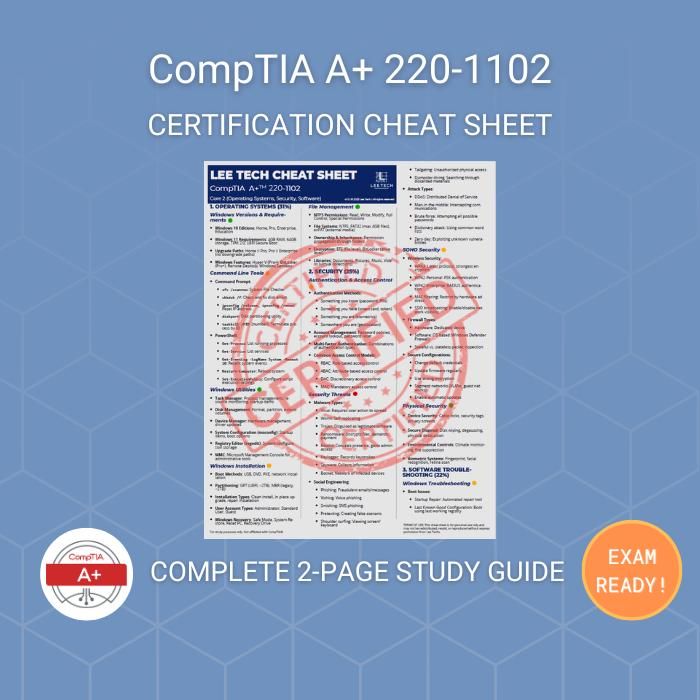
What makes a good certification exam cheat sheet?
An effective cheat sheet focuses on actively retrievable information: formulas you must apply, acronyms with definitions, process sequences in order, and comparison tables that distinguish similar concepts. It should fit one to two printed pages, use consistent visual organization, and be created by writing from memory rather than copying. The process of creating the cheat sheet builds more recall than using a pre-made one.
Cheat sheets are a staple of exam preparation, but most candidates use them ineffectively. The typical approach -- printing someone else's cheat sheet and reviewing it a few times before the exam -- provides minimal benefit. The most effective approach treats the cheat sheet as an active learning tool throughout the preparation process, not a passive reference in the final days.
This guide explains how to create, maintain, and use cheat sheets that genuinely improve certification exam performance.
What Belongs on a Cheat Sheet
Not all study content belongs on a cheat sheet. The selection criteria determines whether a cheat sheet adds value or becomes an unfocused information dump.
Include: High-Frequency Testable Facts
| Category | Examples | Why It Belongs |
|---|---|---|
| Formulas | EVM calculations, PERT, communication channels | Must be applied precisely; one wrong variable causes wrong answer |
| Ordered sequences | Incident response phases, TCP handshake steps | Order matters; confusing steps 3 and 4 changes the meaning |
| Comparison tables | Storage tiers, load balancer types, authentication factors | Exam distractors exploit confusion between similar items |
| Protocol port numbers | 22 SSH, 443 HTTPS, 3389 RDP | Must be recalled instantly; scanning tables during exam is too slow |
| Acronym expansions | CIA triad, AAA, PKI components | Frequently tested; error here costs easy points |
Exclude: Conceptual Material
Cheat sheets are for facts that require precision. Concepts -- like why asymmetric cryptography is slower than symmetric, or why OSPF uses the Dijkstra algorithm -- are better understood than memorized. Including conceptual explanations on a cheat sheet creates a document too long to be useful.
If you find yourself writing paragraphs on a cheat sheet, that content belongs in your study notes, not the cheat sheet.
"The test of what belongs on a cheat sheet is simple: is this something I could get wrong under pressure because I misremember a specific value, order, or comparison? If yes, it belongs. If I need to understand it rather than recall it precisely, it does not." -- Certification preparation framework guide
The Creation Process: Learning Through Making
The single most important principle of cheat sheet creation: always write from memory, then check.
The standard mistake is to read through study materials and copy key facts onto the cheat sheet. This produces a well-organized document but minimal learning, because copying does not require recall.
Effective Creation Method
Step 1: Study -- Read the chapter or domain normally. Understand the content.
Step 2: Close everything -- Put away the book, close the browser tabs.
Step 3: Write from memory -- Write everything you remember about the topic that qualifies for the cheat sheet (formulas, sequences, comparisons).
Step 4: Check against source -- Open your study materials and compare. Add anything you missed. Mark things you wrote incorrectly.
Step 5: Review the gaps -- The items you forgot or got wrong are exactly what to review next. These are your knowledge gaps, made visible by the creation process.
This method turns cheat sheet creation into a practice exam. Each topic you cannot write from memory is a question you would have gotten wrong.
Physical vs. Digital Cheat Sheets
Both formats have legitimate uses:
| Aspect | Physical | Digital |
|---|---|---|
| Review method | Flip through, annotate | Search, scroll, copy-paste |
| Recall practice | Write from memory | Type from memory |
| Accessibility | Requires having the paper | Available on any device |
| Updating | Requires rewriting | Easy to update |
| Pre-exam ritual | Print and review morning of | Study on phone during commute |
| Best for | Final 2-week intensive review | Ongoing preparation |
Some candidates maintain a digital master cheat sheet in a notes application and print a condensed version in the final week. The digital version grows throughout preparation; the printed final version is aggressively trimmed to high-priority items only.
Organization Strategies
By Exam Domain
Organize the cheat sheet to mirror the exam's domain structure. When a question about a specific domain appears on the exam, your mental model of where that information lives mirrors the exam's structure.
For CompTIA Security+ SY0-701:
- Section 1: General Security Concepts (crypto algorithms, authentication factors)
- Section 2: Threats, Vulnerabilities, Mitigations (attack types, malware categories)
- Section 3: Security Architecture (ports, protocols, security zones)
- Section 4: Security Operations (incident response, log types)
- Section 5: Security Program Management (risk formulas, compliance frameworks)
By Mistake Type
An alternative organization is to structure the cheat sheet around your personal weak areas, revealed through practice exam performance.
After completing several practice exams, note which topics caused errors. Build the cheat sheet around those topics. This approach maximizes the marginal return on study time by concentrating on actual gaps rather than reviewing what you already know well.
Comparison-Focused Layout
For certifications where the primary challenge is distinguishing similar concepts (Azure storage tiers, AWS service types, OSPF vs. EIGRP), build the cheat sheet as a series of comparison tables:
| Feature | Option A | Option B | Option C |
|---|---|---|---|
| Use case | ... | ... | ... |
| Performance | ... | ... | ... |
| Cost | ... | ... | ... |
| When to choose | ... | ... | ... |
This layout directly prepares for the exam question format: "A company needs X. Which service should they use?"
Using Cheat Sheets in the Final Preparation Stage
Four weeks before the exam: Create domain-specific cheat sheets as you complete each domain. Focus on identifying what you cannot write from memory.
Two weeks before: Combine domain cheat sheets into a master document. Trim everything that no longer requires active recall (things you now know fluently).
One week before: Review the master cheat sheet once daily. Test yourself by covering answers and trying to recall the information.
Day before the exam: Read the cheat sheet through once in the morning and once in the evening. Do not study new material the day before; this typically causes net harm by introducing uncertainty without building fluency.
Day of exam: If you are allowed to bring scratch paper into the testing room, write down formulas and key sequences immediately when your exam begins, before reading the first question. This prevents the anxiety of "I need to remember that formula" from interfering with reading questions.
Cognitive psychology research on retrieval practice shows that retrieving information from memory is more effective for long-term retention than re-reading it. The cheat sheet creation process, if done from memory, is practicing retrieval, which is why making your own cheat sheet outperforms using someone else's.
Frequently Asked Questions
Should I make my own cheat sheet or download a pre-made one? Make your own. The process of creating a cheat sheet from memory is more valuable for retention than using a pre-made one. Pre-made cheat sheets are useful as a checklist to verify you have not missed high-frequency topics, but they should not replace the creation process.
How long should a cheat sheet be? One to two printed pages for most certifications. If your cheat sheet exceeds two pages, it is probably including conceptual material that belongs in study notes rather than a cheat sheet. The discipline of selecting only the highest-priority content is itself a valuable study process.
How often should I review my cheat sheet? In the final two weeks before the exam, daily review is appropriate. Before that, review after each major study session as a recall check. The frequency should increase as the exam approaches and decrease the coverage as fluency builds.
References
- Roediger, H. L., and Karpicke, J. D. (2006). Test-enhanced learning: Taking memory tests improves long-term retention. Psychological Science, 17(3), 249-255. https://doi.org/10.1111/j.1467-9280.2006.01693.x
- Cepeda, N. J., et al. (2006). Distributed practice in verbal recall tasks: A review and quantitative synthesis. Psychological Bulletin, 132(3), 354-380.
- Dunlosky, J., et al. (2013). Improving students' learning with effective learning techniques. Psychological Science in the Public Interest, 14(1), 4-58.
- Make It Stick: The Science of Successful Learning. Brown, P. C., Roediger, H. L., and McDaniel, M. A. (2014). Harvard University Press.
- CompTIA. (2024). Certification exam preparation best practices. CompTIA Learning Blog.
- Pearson IT Certification. (2024). Exam Cram series cram sheet methodology. https://www.pearsonitcertification.com/
Frequently Asked Questions
What makes a good certification exam cheat sheet?
An effective cheat sheet focuses on formulas, acronyms, process sequences, and comparison tables that distinguish similar concepts. It should fit one to two pages, be created by writing from memory rather than copying, and be organized by exam domain.
Should I make my own cheat sheet or download a pre-made one?
Make your own. The process of creating a cheat sheet from memory is more valuable for retention than using a pre-made one. Pre-made sheets are useful as checklists to verify coverage but should not replace the creation process.
How long should a cheat sheet be?
One to two printed pages for most certifications. If it exceeds two pages, it is probably including conceptual material that belongs in study notes. The discipline of selecting only highest-priority content is itself a valuable study process.