
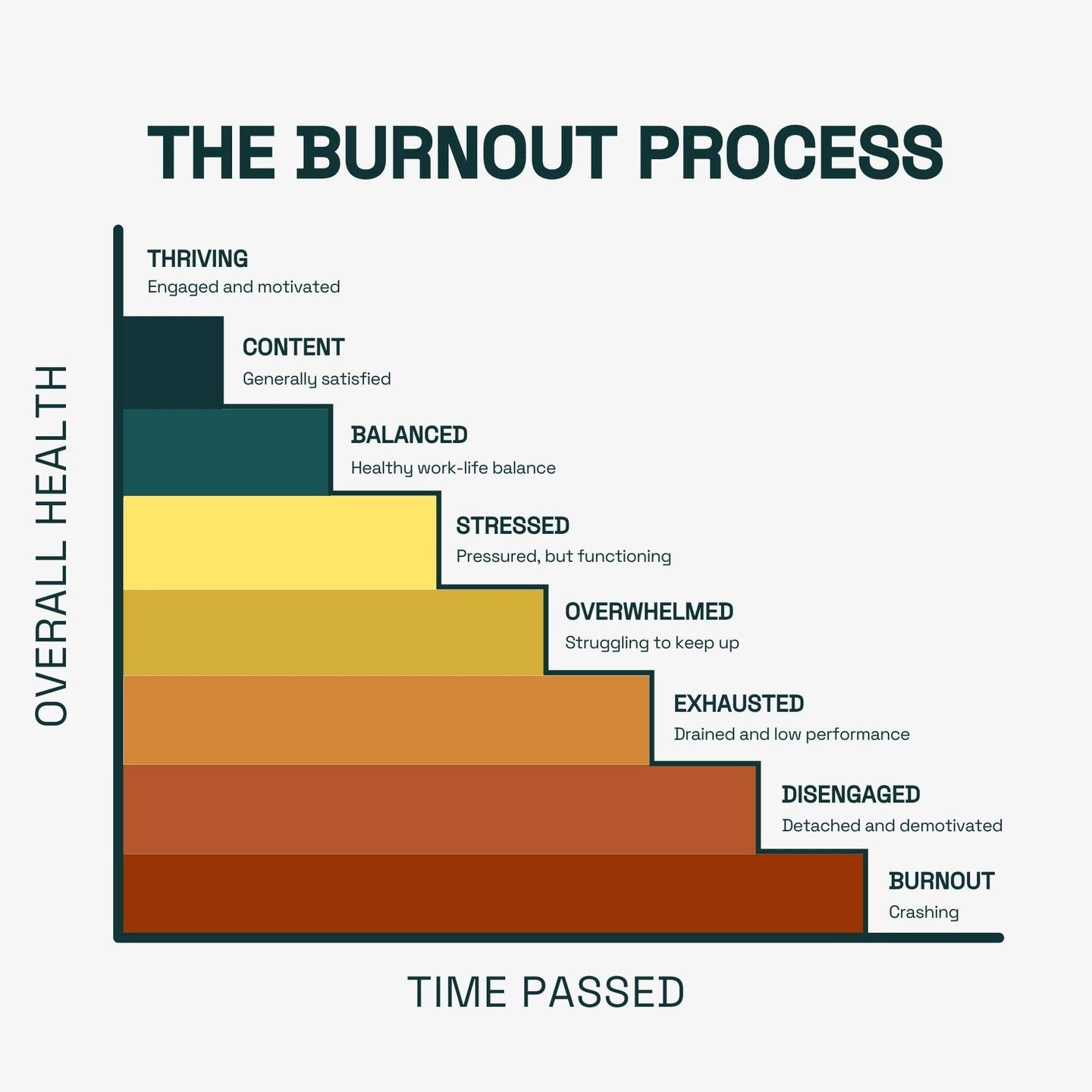
Single-exam study campaigns are hard but bounded. Multi-exam campaigns — the AWS Solutions Architect Associate followed by Professional followed by a specialty, or the Security+ into CySA+ into CISSP progression — run nine to eighteen months and demand a sustainability that single-exam advice does not address. The learning curve in long campaigns is not monotonic. Energy declines, motivation erodes, and the same study habits that worked in week six of a single-exam push collapse in month four of a marathon. Burnout -- a state of physical, emotional, and cognitive exhaustion produced by sustained high-effort engagement without adequate recovery — is the predictable failure mode and the leading cause of mid-marathon exam abandonment.
This article describes how learning curves actually work over multi-month campaigns, the cognitive and physiological signals that precede burnout, and the protective practices that keep candidates productive across long arcs without sacrificing exam outcomes.
The Real Shape of the Learning Curve
The learning curve as commonly drawn — a smooth concave function rising to a plateau — is a marketing simplification. Real learning curves over multi-month campaigns show three distinct phases with characteristic risks at each transition:
- Phase 1: Acquisition (weeks 1-3 of any new exam). New material, high novelty, rapid surface-level progress. Energy expenditure feels productive.
- Phase 2: Consolidation (weeks 4-6). Diminishing returns on new reading, increased frustration with practice tests, the plateau appears.
- Phase 3: Mastery push (weeks 7+). Targeted gap closure, taking practice tests under exam conditions, energy demand spikes.
In a single-exam campaign these three phases compress into six to eight weeks and the candidate finishes before recovery becomes critical. In a multi-exam marathon they cycle repeatedly, with each cycle drawing from a recovery budget that is rarely replenished. By the third exam in a marathon, candidates often start each new acquisition phase already partway down the burnout curve.
A 2001 paper by Christina Maslach, a professor of psychology at UC Berkeley and the developer of the Maslach Burnout Inventory, established that burnout has three dimensions: emotional exhaustion, cynicism or depersonalization, and reduced personal accomplishment. All three apply to long study campaigns: candidates report feeling drained, they grow cynical about whether the certifications are worth the time, and they begin to discount progress they have actually made. Maslach's research showed that burnout is rarely about absolute workload — it is about workload relative to recovery, autonomy, and reward.
"Burnout is not a problem of the people themselves but of the social environment in which they operate. When the workplace does not recognize the human side of work, the risk of burnout increases." -- Christina Maslach, Professor of Psychology, UC Berkeley
For self-directed cert candidates, "the workplace" is the campaign you have built for yourself. The protective practices below are essentially the design rules for a study environment that produces sustainable progress.
Predictive Signals of Burnout
Burnout does not arrive suddenly. It announces itself in a sequence of soft signals that candidates routinely ignore until the signals harden into hard ones. The early signals, in approximate order of appearance:
- Subtle motivation drift: study sessions still happen but feel like obligations rather than chosen work.
- Quality erosion in notes: notes shorten, become bullet points without explanations, drift toward copying.
- Practice test stagnation: scores plateau or decline despite continued study; new wrong answers cluster on previously mastered topics.
- Sleep disruption: difficulty falling asleep on study days, waking earlier than intended, racing thoughts about exam material.
- Social withdrawal: skipping non-study activities to recover energy that should not need recovery.
- Physical symptoms: tension headaches, eye strain, gastrointestinal disruption, persistent low-grade fatigue.
By the time signals 5 and 6 appear, the candidate is in mid-burnout and recovery requires significant time off. The intervention point is signal 1 or 2, and the intervention is structural rather than motivational.
A 2018 longitudinal study by Arnold Bakker, a professor of work and organizational psychology at Erasmus University Rotterdam, of 654 professionals engaged in extended self-directed learning found that participants who tracked weekly self-reports of energy, motivation, and recovery completed their learning programs at a 73% rate, compared to 41% for matched controls who tracked only study hours. The act of self-monitoring produced earlier intervention, which prevented the small problems from compounding into burnout-driven dropout.
Recovery Is a Skill, Not a Default
The biggest mistake candidates make in long marathons is treating recovery as the absence of study rather than as a structured activity. Real recovery has three components:
- Physical recovery: sleep, exercise, time outdoors, nutrition adequate for the cognitive load.
- Cognitive recovery: time when the brain is not solving problems; reading fiction, walking without podcasts, meditation.
- Social recovery: time with people unrelated to the certification, conversations that do not touch the exam material.
The first is widely understood; the second and third are routinely neglected. Cognitive recovery is particularly counter-intuitive because candidates often fill non-study time with podcasts, productivity videos, or technical articles that feel like rest but place continued demands on the same attention systems. A 2010 paper by Marc Berman, then a researcher at the University of Michigan and now at the University of Chicago, on Attention Restoration Theory found that walks in natural environments produced measurable improvements in attention performance, while walks in urban environments did not. The mechanism, originally proposed by Stephen Kaplan, holds that natural environments engage soft fascination -- effortless attention that allows directed-attention systems to recover, while urban environments require sustained directed attention even during nominal rest.
The practical implication: a 30-minute walk through a park is genuinely restorative; a 30-minute scroll through technical Twitter is not. Both feel like breaks; only one allows the cognitive systems used in study to recover.
| Activity | Feels Like Rest | Actually Restorative |
|---|---|---|
| Walk in nature | Yes | Yes |
| Reading fiction | Yes | Yes |
| Light exercise | Yes | Yes |
| Social meal with friends | Yes | Yes |
| Scrolling tech Twitter | Yes | No |
| Productivity podcast | Yes | No |
| Watching exam tip videos | Yes | No |
| Working through "easy" practice questions | Yes | No |
The discipline of recognizing fake rest is the single highest-impact change available to mid-marathon candidates. Most over-study; few under-rest in the technical sense; many do both at once by mistaking continued cognitive load for productive review.
Structural Practices for Long Campaigns
Six structural practices keep multi-month campaigns sustainable. Each is small individually and compounds with the others.
Mandatory Rest Days
Schedule one full rest day per week with zero study activity. Not a light day, not an Anki-only day — zero. The day exists to demonstrate to the cognitive system that the campaign has natural endings, which prevents the diffuse always-on dread that produces motivation drift.
Deload Weeks
Every fourth week, reduce planned study hours by 50%. The reduced week functions like a deload week in strength training: the system consolidates what was acquired in the previous three weeks rather than continuing to push at maximum load. Practice test scores frequently rise during deload weeks because consolidation, not continued input, was the bottleneck.
Inter-Exam Buffers
Between exams in a marathon, schedule a four to six week buffer with no certification study at all. Hobbies, family time, work projects, vacation — whatever uses different cognitive systems. Candidates who book exams back-to-back almost always burn out by exam three; candidates with deliberate buffers complete five-exam marathons at much higher rates.
Sleep as a Hard Constraint
Sleep below seven hours degrades retention measurably. Studies on sleep-dependent memory consolidation by Robert Stickgold, a professor of psychiatry at Harvard Medical School, have shown that declarative memory tasks — exactly the kind certification exams test — are preferentially consolidated during slow-wave sleep, and that sleep restriction below six hours produced retention decrements of 20 to 40% on tasks similar to multiple-choice exam content. Treating sleep as the hard constraint and study time as the variable that adjusts to fit is the rule that produces sustainable performance.
Exercise as a Cognitive Investment
Aerobic exercise three times per week at moderate intensity raises baseline cognitive performance during study sessions. The mechanism, well documented in research by John Ratey, an associate clinical professor of psychiatry at Harvard Medical School and author of Spark: The Revolutionary New Science of Exercise and the Brain, involves elevated brain-derived neurotrophic factor (BDNF) and improved hippocampal volume — both directly relevant to the memory operations cert exams require. Skipping exercise to gain study hours is a near-zero-sum trade because the lost cognitive efficiency cancels the gained time.
Social Accountability Without Social Comparison
A study group or peer pair provides accountability that solo study lacks, but only if structured to share progress without comparing absolute scores. Comparison-driven study groups produce the worst outcomes because they trigger anxiety in lower-scoring members and complacency in higher-scoring ones. The format that works: weekly fifteen-minute calls focused on what each member found surprising, what blocked them, and what they will do next week. Scores are not discussed.
When Burnout Has Already Arrived
If signals 5 and 6 have appeared, the campaign is in burnout. The remediation is not a slight adjustment; it is a structural break.
The protocol that works:
- Stop all study for 7 to 14 days. Not light study — none. Sleep, exercise, social contact, time outdoors.
- Reschedule the exam if booked within 30 days. The fee is recoverable; the failed exam followed by a delayed retake is not.
- Audit the campaign structure before resuming. The burnout is information about what was unsustainable. Resuming with the same structure produces the same outcome.
- Resume at 50% of prior hours for two weeks. Then reassess.
- Reintroduce the protective practices that were dropped: rest days, deload weeks, sleep discipline, exercise.
Candidates resist the seven-day stop because it feels like wasted time near an exam. The data is clear: a candidate in burnout produces low-quality study that often regresses on practice scores, while the same candidate after a structured break frequently rebounds to higher scores than before the burnout. Make It Stick by Peter Brown, Henry Roediger, and Mark McDaniel discusses this rebound effect under the broader heading of desirable difficulty and consolidation, where forced rest from a task can produce performance gains on subsequent attempts.
A Sample 18-Month Marathon Plan
For a candidate pursuing the AWS triple — Solutions Architect Associate, Solutions Architect Professional, and Security Specialty — across 18 months while working full time:
| Months | Activity | Notes |
|---|---|---|
| 1-2 | SAA-C03 study | Acquisition + consolidation |
| 3 | SAA-C03 final + exam | Mastery push, exam, 1 week off |
| 4 | Buffer | No certification study; hobbies, family |
| 5-7 | SAP-C02 study | Three-month campaign with deload weeks |
| 8 | SAP-C02 final + exam | 2 weeks off after exam |
| 9-10 | Buffer | Full recovery period |
| 11-13 | SCS-C02 study | Specialty study, often easier with prior depth |
| 14 | SCS-C02 exam | Final exam |
| 15-18 | Optional buffer | Career consolidation, no new exam booking |
The plan books 4 to 5 months of buffer time across the 18 months. That feels like waste until you compare it to the alternative — a candidate who attempts the same three exams across 12 months with no buffers, burns out around month seven, and either fails the second exam or abandons the third. The longer plan completes; the compressed plan often does not.
The Identity Trap
A subtle contributor to burnout in long marathons is the identity trap -- the candidate begins to define themselves by the campaign, and any threat to the campaign feels like a threat to the self. When study sessions are tied to identity, missing one feels catastrophic, and the cycle of guilt and recovery study compounds the emotional exhaustion that drives burnout.
The mitigation, drawn from work by Carol Dweck, a psychologist at Stanford whose research on growth mindset documented the difference between identity-tied and process-tied frames, is to describe the campaign in process terms rather than identity terms. "I am studying for the SAA-C03" is process. "I am someone who is studying for certifications" is identity. The first allows pauses without self-recrimination; the second does not.
Candidates who pass long marathons almost universally describe their relationship to the campaign in process terms after the fact, even if they began in identity terms. The earlier the process framing is adopted, the smoother the recovery from inevitable disruptions becomes.
A practical reframing technique: replace I am studying for X with I am running a 12-week study process for X. The tag process:active next to a campaign name in your knowledge base or planning tool reinforces the framing. When the process ends — whether through passing the exam, deferring the exam, or rescoping the goal — the tag changes to process:complete or process:paused. The campaign is something you do, not something you are.
Reading the Curve: When to Push and When to Rest
The single hardest skill in long marathons is reading your own learning curve well enough to know whether the current week calls for a push or for rest. Three diagnostic signals separate the two:
- Practice test trajectory: scores rising week-over-week mean continued input is producing returns; push. Scores flat or falling for two consecutive weeks mean consolidation is the bottleneck; rest or deload.
- Note quality trajectory: notes growing in length and link density mean the brain is actively building structure; push. Notes shortening or becoming bullet-only mean cognitive bandwidth is depleted; rest.
- Subjective effort ratio: if a 90-minute box still feels like a 90-minute box, push. If it feels like a 150-minute box, the underlying capacity has shrunk and rest is the productive choice.
Candidates who learn to read these signals accurately complete marathons at much higher rates than candidates who push uniformly regardless of state. The signals are individually noisy but collectively reliable; tracking all three weekly produces a clear pattern that drives confident decisions about whether to maintain pace, accelerate, or pull back.
This is the practice that Make It Stick describes as calibrated effort — adjusting the intensity to match current capacity rather than holding to an arbitrary plan made weeks earlier. The plan is the starting point. The signals are what tell you when the plan needs to change.
See also: /exam-prep/study-techniques/building-a-study-schedule, /exam-prep/study-techniques/eliminating-distractions-during-study, /exam-prep/memory-retention/sleep-and-memory-consolidation, /certifications/aws/aws-multi-cert-roadmap
References
- Maslach, C., Schaufeli, W. B., & Leiter, M. P. (2001). Job Burnout. Annual Review of Psychology, 52, 397-422.
- Bakker, A. B., & Demerouti, E. (2017). Job Demands-Resources Theory: Taking Stock and Looking Forward. Journal of Occupational Health Psychology, 22(3), 273-285.
- Berman, M. G., Jonides, J., & Kaplan, S. (2008). The Cognitive Benefits of Interacting With Nature. Psychological Science, 19(12), 1207-1212.
- Stickgold, R. (2005). Sleep-Dependent Memory Consolidation. Nature, 437(7063), 1272-1278.
- Ratey, J. J. (2008). Spark: The Revolutionary New Science of Exercise and the Brain. Little, Brown Spark. ISBN 978-0316113502.
- Dweck, C. S. (2006). Mindset: The New Psychology of Success. Random House. ISBN 978-1400062751.
- Brown, P. C., Roediger, H. L., & McDaniel, M. A. (2014). Make It Stick: The Science of Successful Learning. Belknap Press of Harvard University Press. ISBN 978-0674729018.
Frequently Asked Questions
How do I know if I am burning out or just having a hard week?
A hard week resolves with one good night of sleep and a rest day. Burnout does not. The diagnostic signals are persistent motivation drift, quality erosion in your notes, practice test stagnation despite continued study, sleep disruption, social withdrawal, and physical symptoms like tension headaches or persistent fatigue. If three or more of these have been present for two weeks, you are in burnout, not a hard week, and the response is structural rather than motivational.
Are deload weeks really necessary for cert study?
For multi-exam marathons, yes. Every fourth week reduce planned study hours by 50%. Practice test scores frequently rise during deload weeks because consolidation, not continued input, was the bottleneck preventing further gains. Single-exam campaigns of six to eight weeks can usually skip deload weeks because the campaign ends before the recovery debt becomes critical.
What counts as real recovery between study sessions?
Activities that do not place demands on the same attention systems your study uses. Walks in natural environments, fiction reading, light exercise, social time with people unrelated to the certification. Activities that feel like rest but are not include scrolling technical Twitter, listening to productivity podcasts, watching exam tip videos, or working through easy practice questions. The fake rest activities sustain the cognitive load you were trying to release.