
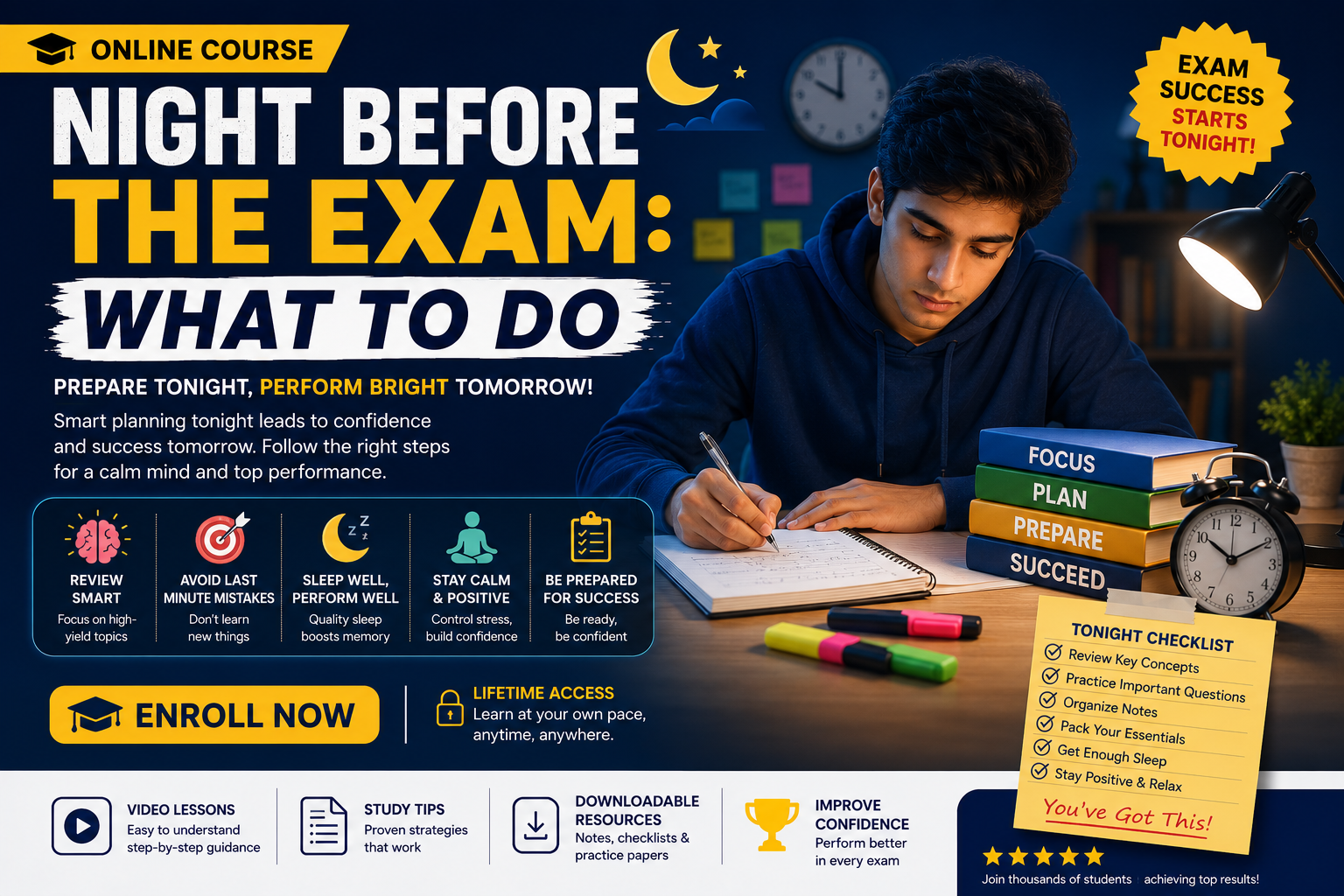
Should I study the night before a certification exam?
Limit review to brief scanning of summary notes or flashcards you already know. Stop all study activity at least 4-6 hours before bed. Cramming new material causes retroactive interference, where fresh information disrupts recall of previously learned content under exam pressure.
The 18 hours before a certification exam carry disproportionate influence over your performance. Research from cognitive science and performance psychology consistently shows that pre-exam behavior affects test scores independently of total study hours. A 2019 study published in the Proceedings of the National Academy of Sciences by researchers at MIT found that students who slept fewer than six hours the night before an exam scored an average of 17.5% lower than their well-rested peers, even when total study time was equivalent.
For certification candidates who have invested weeks or months preparing for exams like the AWS Solutions Architect Associate, PMP, CISSP, or CompTIA Security+, the final night represents both an opportunity and a risk. What you do - and critically, what you avoid - during this window can be the difference between passing and scheduling a retake.
Stop Studying New Material by Early Evening
This is the most counterintuitive recommendation and the one candidates resist most. The impulse to cram until midnight feels productive but actively harms performance.
Retroactive interference - a memory phenomenon where newly learned information disrupts recall of previously learned material. When you study new topics the night before an exam, the fresh information competes with the knowledge you have been building for weeks. This is not speculation; it is one of the most replicated findings in memory research.
Henry Roediger III, a professor of psychology at Washington University in St. Louis and co-author of Make It Stick: The Science of Successful Learning, has spent decades studying how memory works under test conditions.
"Last-minute cramming creates the illusion of knowledge. The material feels familiar because you just read it, but familiarity is not the same as retrievable understanding. Under exam pressure, recently crammed information is the first to become inaccessible." - Henry Roediger III, Professor of Psychology, Washington University
What to Do Instead
If you must review something, limit yourself to:
- Scanning your own summary notes or flashcards (material you already know)
- Reviewing a one-page cheat sheet you created during your study period
- Doing one final pass over mnemonics or memory aids you have been using
The goal is reinforcement, not acquisition. You are strengthening existing neural pathways, not building new ones.
The Cutoff Timeline
| Time Before Exam | Activity |
|---|---|
| 6+ hours | Final light review of summary notes only |
| 4-6 hours | Stop all study activity |
| 3-4 hours | Relaxing activity (walk, light entertainment) |
| 2-3 hours | Prepare exam logistics (ID, directions, login test) |
| 1 hour before bed | Wind-down routine (no screens) |
Prepare Your Exam Logistics Early
Administrative anxiety is a silent performance killer. Candidates who scramble on exam morning to find their testing center, locate their ID, or troubleshoot their webcam for online proctoring arrive at the exam in a stress state that impairs cognitive function.
For Testing Center Exams (Pearson VUE, PSI, Prometric)
Complete these tasks by early evening:
- Confirm your appointment time and location - log in to the testing provider's website and verify the address, not just the center name
- Plan your route including parking or public transit, adding 30 minutes of buffer time
- Prepare two forms of government-issued ID (most testing centers require this for exams like
CISSPorPMP) - Set two alarms for the morning, using different devices
- Lay out your clothes and any permitted items the night before
For Online Proctored Exams
Online proctoring has become standard for many certification exams including Microsoft, AWS, and CompTIA certifications. Technical failures are the leading cause of exam day disruptions for remote test-takers.
Complete these steps the evening before:
- Run the system check provided by the proctoring software (Pearson OnVUE, PSI Bridge, or the vendor's proprietary tool)
- Test your webcam, microphone, and internet connection - wired Ethernet is strongly recommended over Wi-Fi
- Clear your desk completely - proctors will ask you to show your workspace via webcam and will flag any papers, books, or secondary monitors
- Close all unnecessary applications and disable automatic updates on your computer
- Inform household members of your exam time so they do not enter the room or create noise
- Charge your laptop fully and keep the power cable connected
A 2023 report by Pearson VUE found that 8% of online proctored exams experienced significant disruptions, with internet connectivity issues (41%), background noise violations (23%), and software conflicts (19%) as the top three causes.
Sleep: The Non-Negotiable Factor
Sleep is not merely rest - it is an active cognitive process during which your brain consolidates memories, strengthens neural connections, and clears metabolic waste products that impair function. For certification candidates, the sleep the night before an exam is arguably the single most impactful variable within your control.
The Science of Pre-Exam Sleep
Sleep consolidation - the process by which the brain transfers information from short-term to long-term memory during sleep, particularly during slow-wave sleep (deep sleep) and REM cycles. This process is why studying over multiple days with sleep between sessions outperforms equivalent hours of continuous study.
Matthew Walker, a professor of neuroscience at the University of California, Berkeley and author of Why We Sleep: Unlocking the Power of Sleep and Dreams, has documented the relationship between sleep and cognitive performance extensively.
"Sleep is not the absence of wakefulness. It is a complex series of brain states that serve memory, creativity, and emotional regulation. Sacrificing sleep to study more is like training for a marathon by skipping meals - you are removing the very thing that makes the training effective." - Matthew Walker, Professor of Neuroscience, UC Berkeley
Practical Sleep Guidelines for Exam Eve
- Target 7-8 hours of sleep - not 6, not 5, and definitely not "I'll sleep after the exam"
- Maintain your normal bedtime rather than going to bed early (lying awake anxiously is worse than your normal schedule)
- Avoid caffeine after 2:00 PM - caffeine has a half-life of approximately 5-6 hours, meaning half the caffeine from a 3:00 PM coffee is still in your system at 9:00 PM
- Limit alcohol entirely - even one drink disrupts sleep architecture, particularly REM sleep, which is critical for memory consolidation
- Dim lights and avoid screens for 60 minutes before bed - blue light from phones and laptops suppresses melatonin production
If you have trouble falling asleep due to pre-exam anxiety, a body scan relaxation technique or slow breathing (4-count inhale, 7-count hold, 8-count exhale) can activate the parasympathetic nervous system and reduce physiological arousal.
Nutrition and Hydration: What Works and What Does Not
What you eat and drink the evening before your exam affects your cognitive performance the following morning. This is not about optimization hacking - it is about avoiding self-inflicted impairments.
Evening Meal Guidelines
- Eat a normal-sized dinner with a balance of protein, complex carbohydrates, and vegetables
- Avoid heavy, greasy, or unfamiliar foods that might cause digestive discomfort overnight or the next morning
- Skip excessively spicy food if you are not accustomed to it
- Stay hydrated but reduce fluid intake in the final two hours before bed to minimize overnight bathroom trips
What to Prepare for Exam Morning
For testing center exams, prepare your morning meal the night before:
- A moderate breakfast with protein and complex carbs (eggs, oatmeal, whole grain toast)
- Water and moderate caffeine if you are a regular caffeine consumer (do not introduce caffeine for the first time on exam day)
- A small snack for the break period if your exam allows one (the
PMPexam has a 10-minute break, theCISSPhas no scheduled breaks in the CAT format)
Glucose depletion - the reduction in blood glucose levels during sustained mental effort, which impairs decision-making, attention, and working memory. A 2011 study by Gailliot and Baumeister published in Personality and Social Psychology Review found that cognitive tasks deplete glucose and that maintaining stable blood sugar improves sustained performance.
Mental Preparation: Managing Pre-Exam Anxiety
Pre-exam anxiety is not a character flaw - it is a physiological response that affects nearly all candidates to some degree. The question is not whether you will feel anxious but whether you manage it effectively.
Reframing Anxiety as Activation
Research by Alison Wood Brooks at Harvard Business School, published in the Journal of Experimental Psychology: General (2014), found that reframing anxiety as excitement improved performance on public speaking and math tasks. Participants told to say "I am excited" before a challenging task performed significantly better than those told to "try to calm down."
For certification candidates, this means:
- Acknowledge the physical sensations (elevated heart rate, sweaty palms) as your body preparing for performance
- Replace "I'm nervous about tomorrow" with "I'm ready to show what I know"
- Recall the total hours you have invested and the practice exam scores you have achieved
Visualization Technique
Spend 5-10 minutes the evening before your exam mentally walking through the exam experience:
- Visualize arriving at the testing center or logging into the proctoring software
- See yourself reading the first question calmly and identifying what it asks
- Imagine encountering a difficult question, flagging it, and moving forward without panic
- Picture completing the exam and seeing a passing result
This is not wishful thinking - visualization activates the same neural pathways as actual experience. Athletes have used this technique for decades, and research supports its application to cognitive performance tasks.
Physical Preparation: Your Body Affects Your Brain
Cognitive performance on exam day depends on physical state more than most candidates realize. The night before is your final opportunity to set up optimal physical conditions.
Exercise Timing
Moderate exercise (a 30-minute walk, light jog, or yoga session) in the late afternoon or early evening has been shown to improve sleep quality and reduce anxiety. A 2013 study published in the Journal of Sleep Research by Kredlow and colleagues found that acute exercise 4-8 hours before bedtime improved sleep onset latency (the time it takes to fall asleep) by an average of 12 minutes compared to sedentary evenings.
However, intense exercise within 2-3 hours of bedtime can have the opposite effect, elevating cortisol and core body temperature, both of which interfere with sleep onset.
Temperature and Environment
Your sleep environment matters more than usual the night before an exam. The National Sleep Foundation recommends a bedroom temperature between 60-67 degrees Fahrenheit (15-19 degrees Celsius) for optimal sleep. If you do not normally control your bedroom temperature, the night before an important exam is a good time to start.
Additional environmental factors:
- Use blackout curtains or a sleep mask to eliminate light disruptions
- Set your phone to Do Not Disturb mode at least 30 minutes before your target bedtime
- If you live in a noisy environment, consider earplugs or a white noise machine
- Remove any visible study materials from your bedroom - seeing your notes can trigger rumination and anxiety
The Morning-of Plan
Decide the night before exactly what your exam morning will look like, minute by minute. This eliminates decision-making during a period when your cognitive resources should be conserved for the exam itself. Write down:
- Wake-up time (allow at least 90 minutes before departure or exam start)
- Breakfast plan (prepared the night before)
- Departure time or login time (with 30-minute buffer)
- What you will do during the buffer time (light stretching, breathing exercises, or simply sitting quietly)
Real-world example: When Google Cloud launched its certification program, their recommended candidate preparation guide specifically advised exam-takers to "script your morning" the night before, treating the exam like a job interview where punctuality and calm demeanor matter as much as knowledge.
What to Absolutely Avoid
Do Not Take Practice Exams the Night Before
This is the most common mistake. A practice exam that produces a low score the night before your real exam creates a negative psychological spiral. Even a high score provides minimal benefit because you have no time to act on the results.
Real-world example: Marcus Thompson, a network engineer preparing for the CCNA 200-301 exam, took a practice test at 10 PM the night before his exam and scored 62%. He spent the next three hours frantically reviewing missed topics, slept four hours, and failed his actual exam with a score of 710 (passing is 825). His instructor later noted that Marcus had been consistently scoring above 850 on practice exams in the weeks prior.
Do Not Change Your Study Strategy
If you have been using flashcards for two months, do not suddenly decide to read the entire CompTIA CertMaster guide cover-to-cover the night before. Stick with what has been working.
Do Not Consume Excessive Caffeine or Energy Drinks
The energy drink industry markets products as cognitive enhancers, but the combination of high caffeine, sugar, and taurine disrupts sleep quality and can cause jitteriness that impairs focus during the exam.
Do Not Engage with Exam Forums or Social Media
Reading other candidates' horror stories about exam difficulty or encountering unfamiliar topics mentioned by others will increase anxiety without improving your knowledge.
Do Not Skip Your Nighttime Routine
If you normally read before bed, watch a show, or take a walk - do it. Disrupting your routine signals to your brain that something unusual is happening, making it harder to fall asleep.
A Complete Pre-Exam Evening Checklist
Use this checklist for any certification exam, whether AZ-104, PMP, CISSP, or AWS SAA-C03:
- Exam confirmation email reviewed (time, location, appointment ID)
- Two forms of ID located and placed by the door or desk
- Route planned with buffer time (testing center) or system check completed (online)
- Final light review of summary notes completed before 6:00 PM
- Dinner eaten at a normal time with familiar foods
- Clothes laid out for tomorrow
- Alarms set on two devices
- Phone set to Do Not Disturb
- Screens off 60 minutes before bed
- 7-8 hours of sleep targeted
The night before your certification exam is not the time to become a different person. It is the time to protect the investment you have already made. Every decision should serve one purpose: arriving at the exam rested, calm, and logistically prepared.
See also: Managing test anxiety during certification exams, building an effective certification study plan, how to use practice exams for real knowledge gap analysis
Is Comptia Security Test Hard?
The CompTIA Security+ SY0-701 test ($404, 90 questions, 90 minutes, 750/900 passing) is rated moderately hard. First-attempt pass rates hover around 82% with proper preparation (40-60 hours). The challenging parts are the 3-5 performance-based questions (PBQs) at the start, which simulate firewall configuration, log analysis, and attack attribution; most test-takers flag and return to these. The remaining multiple-choice questions reward memorization of acronyms (SIEM, SOAR, EDR, XDR, ZTNA) and scenario judgment. Professor Messer's free YouTube course plus Jason Dion's Udemy practice exams ($20) are the most-recommended prep combo.
References
- Okano, Kana, et al. "Sleep quality, duration, and consistency are associated with better academic performance in college students." Proceedings of the National Academy of Sciences, 116(46), 2019.
- Walker, Matthew. Why We Sleep: Unlocking the Power of Sleep and Dreams. Scribner, 2017.
- Brown, Peter C., Henry L. Roediger III, and Mark A. McDaniel. Make It Stick: The Science of Successful Learning. Harvard University Press, 2014.
- Brooks, Alison Wood. "Get Excited: Reappraising Pre-Performance Anxiety as Excitement." Journal of Experimental Psychology: General, 143(3), 2014.
- Pearson VUE. "Online Proctoring: Candidate Experience Report 2023." Pearson VUE, 2023.
- Gailliot, Matthew T., and Roy F. Baumeister. "The Physiology of Willpower: Linking Blood Glucose to Self-Control." Personality and Social Psychology Review, 11(4), 2007.
Frequently Asked Questions
Should I study the night before a certification exam?
Limit review to brief scanning of summary notes or flashcards you already know. Stop all study activity at least 4-6 hours before bed. Cramming new material causes retroactive interference, where fresh information disrupts recall of previously learned content under exam pressure.
How much sleep do I need before a certification exam?
Target 7-8 hours of sleep the night before your exam. Research from MIT found that students sleeping fewer than six hours scored 17.5% lower than well-rested peers. Avoid caffeine after 2 PM and alcohol entirely, as both disrupt sleep architecture critical for memory consolidation.
What should I eat the night before and morning of a certification exam?
Eat a normal dinner with protein, complex carbohydrates, and vegetables. Avoid heavy, greasy, or unfamiliar foods. For exam morning, prepare a moderate breakfast with protein and complex carbs. Maintain stable blood sugar to support sustained cognitive performance during the test.