
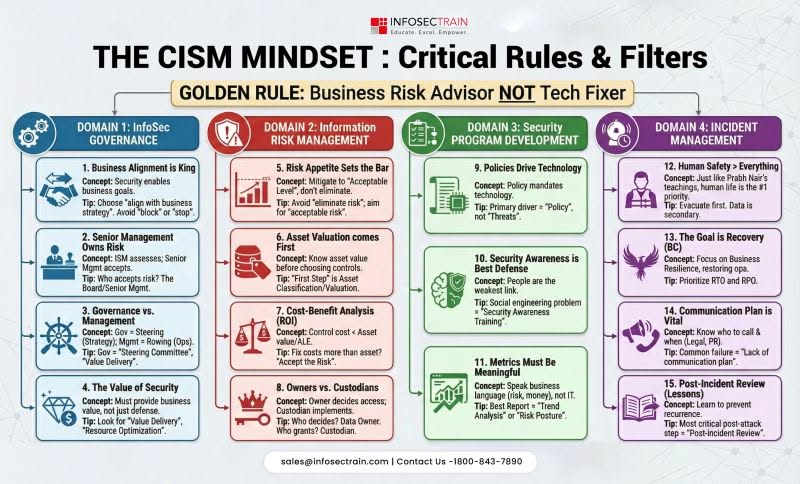
The CISM exam doesn't ask you how a firewall works. It asks you what you do when the board wants to know the organization's risk posture before the next merger. Forty-three percent of CISMs earn more than $120,000 annually according to ISACA's 2023 salary survey — and that premium exists precisely because the CISM tests management capability, not technical depth. If you're trying to move from security practitioner to security manager, this is the credential that signals the transition.
The 4 domains and their exam weights
CISM covers four domains, and understanding their weights helps allocate study time correctly:
| Domain | Name | Weight |
|---|---|---|
| 1 | Information Security Governance | 17% |
| 2 | Information Risk Management | 20% |
| 3 | Information Security Program | 33% |
| 4 | Incident Management | 30% |
Domain 3 (Information Security Program) at 33% is the largest single domain and the one that determines whether most candidates pass or fail. It covers security program development, management, and oversight — everything from building a security strategy aligned with business objectives, to managing security budgets, to selecting and implementing security controls at an organizational level.
Domain 4 (Incident Management) at 30% covers incident response at the management level — not the technical execution of incident response, but the governance, escalation, communication, and business continuity aspects of managing a security incident.
Together, Domains 3 and 4 represent 63% of the exam. Candidates who spend equal time on all four domains systematically under-prepare for the content that decides their score.
What Domain 3 (Information Security Program, 33%) specifically tests
Domain 3 is the core of what separates the CISM from a technical security certification. It tests whether you can run a security program, not whether you understand security technology. Specific sub-areas the exam covers:
Security program development:
Aligning the security program with business objectives and corporate governance frameworks
Defining the information security strategy and roadmap
Obtaining executive sponsorship and board-level buy-in for security investments
Building a security program budget and justifying it in terms of business risk reduction
Security controls management:
Selecting security controls based on risk assessment results (not based on technical preference)
Measuring the effectiveness of implemented controls through metrics and KPIs
Managing exceptions to security policy — when exceptions are granted, how they're documented, and how they expire
Third-party risk management:
Vendor risk assessment processes before onboarding
Contractual security requirements (SLAs, right-to-audit clauses, breach notification terms)
Ongoing monitoring of vendor security posture
The exam tests whether you understand that every security decision in a program context must connect back to a business risk and a business objective. Technical answers that don't address the governance layer will consistently be wrong.
How CISM differs from CISSP
The most common question from candidates who hold or are studying for CISSP: is CISM redundant? The answer is no, but the overlap is real.
CISSP is broad and deep. It covers eight domains including cryptography, network protocols, security architecture, software development security, and IAM — technical areas that CISM doesn't test at all. CISSP's governance content (Domain 1) is approximately 16% of the exam.
CISM is narrow and management-focused. It tests whether you can manage a security program, not whether you understand security technology. A CISM candidate doesn't need to know how AES works or what the TLS handshake looks like.
| Factor | CISM | CISSP |
|---|---|---|
| Technical depth | Low | High |
| Management focus | Very high | Moderate (Domain 1 only) |
| Governance content | 100% of exam | ~16% of exam |
| Target role | Security manager, CISO, director | Security architect, senior engineer, CISO |
| Experience requirement | 5 years (3 in management) | 5 years (or 4 with degree) |
The practical career difference: CISSP opens doors to technical security architect and senior security engineer roles. CISM opens doors to security manager, CISO, and VP of Information Security roles. The same person often holds both — a CISO who knows the technical stack while managing the strategic program.
"CISM isn't just harder to earn than CISSP from a study standpoint — it's harder to qualify for. You need to have actually managed something. That's the real filter, and it's why CISMs command a salary premium." — Brian Krebs, security journalist and industry observer
Experience requirement: 5 years with 3 in management
The CISM experience requirement has a management-specific component that CISSP doesn't have:
5 years of information security work experience total
Of those 5 years, at least 3 must be in information security management
The 3 years in management must span at least 2 of the 4 CISM domains
"Management" is defined by ISACA as work experience in managing, designing, overseeing, or assessing an enterprise's information security, not just performing security tasks as an individual contributor. A senior penetration tester with 5 years of experience doesn't automatically qualify unless they were managing the security testing program, not just performing tests.
ISACA's exam style: the situational question format
ISACA exams are famous for their situational question format. You're not asked to define a term or identify a protocol. You're presented with a scenario and asked what you would do first, next, or instead.
Scenario-based example: "The CISO has been informed that a key vendor has suffered a data breach affecting the organization's customer records. The first action the CISO should take is:"
A. Notify customers of the potential impact
B. Assess the contractual obligations with the vendor
C. Engage legal counsel to review the incident
D. Determine the scope and nature of the data compromised
The correct answer is D — you must understand what happened before doing anything else.
Three core principles for ISACA questions:
Risk-based thinking: the answer that addresses the greatest risk to the organization is usually right
Governance-first: governance and policy answers outrank technical implementation answers
Communication to leadership: escalating to senior management or the board is often the correct first step
Study resources: the ISACA question bank as the primary tool
Three primary study resources worth your time:
ISACA CISM Review Manual (2023 edition): The authoritative source. Read it once for comprehension, not memorization. The manual explains ISACA's reasoning for their answer patterns, which is more valuable than memorizing any specific question.
ISACA Question, Answer and Explanation (QA&E) Database: Available as a subscription through ISACA. Contains 1000+ practice questions with explanations. The QA&E database is considered the single most important study resource because ISACA's actual exam questions are drawn from the same question bank logic. Candidates who work through the entire QA&E database consistently outperform candidates who used only third-party practice tests. Do every question, read every explanation for wrong answers, and track which domains you're weak on.
CISM All-In-One Exam Guide by Peter Gregory (McGraw-Hill): A solid supplement to the official manual. More readable than the ISACA manual and includes practice questions with detailed explanations.
Study approach that works for CISM:
Read the ISACA Review Manual chapters on Domain 3 and Domain 4 first (the heaviest-weighted domains)
Complete 50 QA&E practice questions per day, spending 2-3 minutes per incorrect answer reading the explanation
After 4 weeks, take a full 150-question timed practice exam to identify weak domains
Spend 2 additional weeks on your two weakest domains using the QA&E database filtered by domain
Final week: full practice exams only, targeting 75%+ consistently before scheduling the real exam
Salary premium data for CISM holders
ISACA's 2023 Global Cybersecurity Skills and Salary Study surveyed 2,500+ security professionals globally. Key findings for CISM holders:
| Region | Median CISM Holder Annual Salary |
|---|---|
| United States | $131,000 |
| Canada | $115,000 |
| United Kingdom | $92,000 |
| Australia | $118,000 |
| India | $28,000 |
These salaries represent medians across CISM holders, most of whom have titles like security manager, director of information security, or CISO. Entry-level candidates cannot expect these salaries immediately after passing the CISM — the experience requirement ensures most CISM holders have the job history to command them.
Real examples: Thomas, a security operations manager at a regional bank, received a 22% salary increase after passing CISM and formally taking the title of Information Security Manager. His employer tied the salary band to the credential. Lakshmi, who moved from senior security analyst to information security program manager at a healthcare system, credited her CISM application with demonstrating she understood governance frameworks well enough for the step up.
The CISM vs CISSP career decision
For candidates trying to decide which to pursue:
If your goal is technical senior roles (security architect, principal engineer, red team lead): pursue CISSP first
If your goal is management roles (security manager, CISO, director of IS): pursue CISM first or alongside CISSP
If you already hold CISSP and are moving into management: CISM is the natural next step
If you're early in your career (under 5 years experience): you likely don't yet qualify for CISM and should start with CISSP or CompTIA certifications
The management orientation of CISM also makes it relevant for people entering security from non-technical fields. An experienced project manager, attorney, or compliance officer who moves into a security management role might find CISM more appropriate than CISSP for their specific knowledge needs.
The CISM exam format and logistics
The CISM exam is 150 questions, 4 hours, with a passing score of 450 out of 800. The exam is delivered through Kryterion testing centers worldwide and remote proctoring. Cost is $575 for ISACA members and $760 for non-members. ISACA membership itself costs $135/year, making membership worthwhile if you plan to take the exam.
The 4-hour window gives you 1.6 minutes per question — tighter than many other management-level certifications. The scenario-heavy questions require reading a full paragraph before the answer choices, so speed reading the stem and identifying the core question before reading all four answers is a valuable technique.
Exam scheduling tip: CISM is available year-round at testing centers. The wait time for test center appointments varies by location — major US cities typically have availability within 2-3 weeks, while smaller markets may require 4-6 weeks of lead time. Remote proctoring typically has next-day availability.
A numbered checklist for the CISM exam day:
Arrive at the testing center 15-20 minutes early for identity verification
You're allowed a physical whiteboard or scratch paper (erasable) — use it for tracking which domain each question maps to if you're trying to identify patterns
Flag questions where you're unsure between two answers and return to them after completing the full exam
In the final 30 minutes, review only flagged questions — don't second-guess answers you answered confidently
Apply the risk-first filter to every flagged question: "which answer addresses the greatest organizational risk?"
See also: CISSP domains ranked by difficulty: where most candidates lose points, CompTIA Security+ as a CISSP stepping stone: the logical path
References
ISACA. (2024). CISM Exam Information. https://www.isaca.org/credentialing/cism
ISACA. (2023). CISM Review Manual, 16th Edition. ISACA. ISBN: 978-1604207019
ISACA. (2023). Global Cybersecurity Skills and Salary Study. https://www.isaca.org/go/state-of-cybersecurity-2023
Gregory, P. H. (2022). CISM Certified Information Security Manager All-in-One Exam Guide, 3rd Edition. McGraw-Hill. ISBN: 978-1260469936
ISACA. (2024). CISM Experience Requirements. https://www.isaca.org/credentialing/cism/get-cism-certified
Cannon, D. L. (2022). CISA Certified Information Systems Auditor Study Guide, 5th Edition. Sybex. ISBN: 978-1119894629
Frequently Asked Questions
What is the CISM experience requirement?
CISM requires 5 years of information security work experience, with at least 3 of those years in information security management roles. Management experience must span at least 2 of the 4 CISM domains. A graduate degree or certain approved certifications can substitute for one year, but a minimum of 3 years of actual work experience is always required.
Is CISM harder than CISSP?
The two exams test different things, making direct comparison difficult. CISSP tests broader technical knowledge across 8 domains. CISM tests management judgment across 4 domains using scenario-based questions. Many technical practitioners find CISM’s management-focused questions more challenging because they require governance thinking rather than technical problem-solving.
What salary can a CISM holder expect?
ISACA’s 2023 salary survey shows US CISM holders earning a median of \(131,000 annually. This figure reflects that most CISM holders occupy security manager, director, or CISO positions. New CISM holders with limited management experience will likely earn in the \)85,000-$100,000 range and grow into the higher salary bands over time.
What study materials does ISACA recommend for CISM?
ISACA recommends their official CISM Review Manual as the primary study resource, supplemented by the ISACA Question, Answer and Explanation (QA&E) database with over 1,000 practice questions. Third-party resources like Peter Gregory’s CISM All-in-One Exam Guide are widely used alongside official materials.
What is the CISM passing score?
CISM uses a scaled scoring system ranging from 200 to 800. A score of 450 or higher is required to pass. The scaling means that raw question scores are converted to the 200-800 scale, so the effective passing percentage varies by exam version. ISACA targets a 65-75% correct rate on the raw questions as a rough guide.